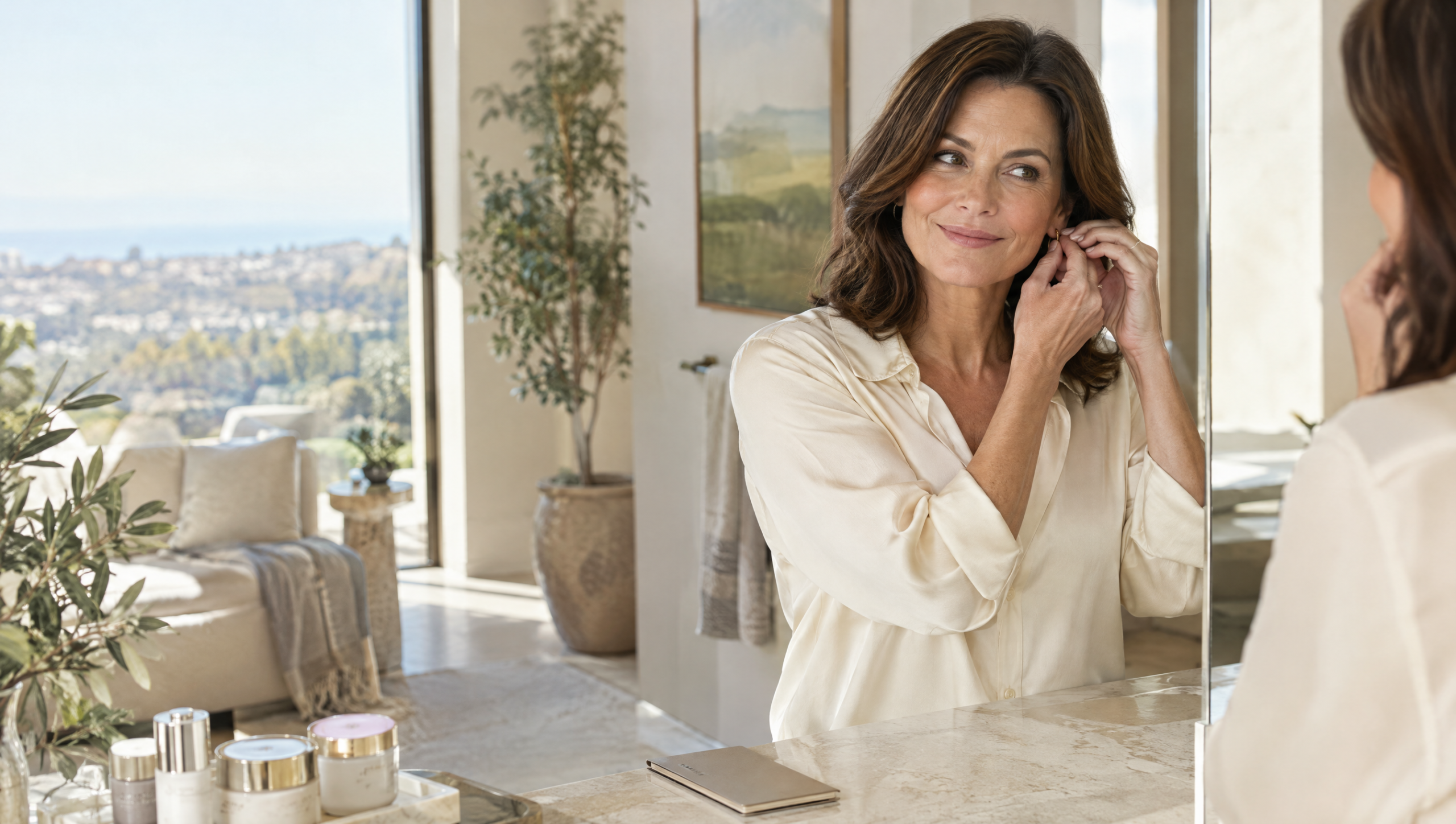
In Orange County, a great facelift can make you the envy of the dinner table. An obvious one can make you the evening’s entertainment. Somewhere between aging gracefully and trying too hard, we’ve invented an entire rulebook for looking younger, and I’m beginning to wonder why any of us agreed to play.
I’m 52, and I’ve never had plastic surgery. And I’ll confess something slightly embarrassing: every so often, I’ve been rather pleased with myself about that.
Someone compliments my skin, and before I can stop myself, I’m volunteering information nobody requested. “Oh, thank you! You know, I’ve actually never had any work done. I haven’t even had Botox in almost a year!” I say it as if I’ve just accepted a lifetime achievement award.
An award for what, exactly? Good genetics? Being lucky enough not to have felt the need for surgery yet? Having a face that’s been relatively cooperative for five decades? Congratulations to me, I suppose.
The more I think about it, the sillier that little flash of pride seems, especially because I’m not remotely opposed to plastic surgery. I’ve used Botox. I love good skincare, smart aesthetic treatments and pretty much anything that helps us look and feel our best. If someone offered me the chance to look like an even better version of myself, I’d absolutely be interested. So why am I so eager to announce that I haven’t needed much help getting here?
Maybe because, somewhere along the way, we created one of the strangest competitions in modern life. We all want to look younger. We just want everyone to believe we did it naturally. And nowhere is that contradiction more entertaining than in a certain sun-drenched corner of Orange County, where cosmetic procedures are practically on the social calendar, everyone knows someone who’s had a facelift, and a good surgeon’s name travels through a dinner party faster than the juiciest piece of gossip.
The facelift everyone admires. Until dinner.
There’s a peculiar little ritual that unfolds when someone walks into a room looking noticeably younger than she did six months ago. It comes in four acts.
First, admiration: She looks incredible. Then curiosity: Who did her face? Then the financial audit: I heard it cost an absolute fortune. And finally, if the evening runs long enough, the verdict: Don’t you think she was a little young to have that done?
What’s remarkable is that all four reactions can come from the very same person, sometimes within the same conversation. And somewhere between the second glass of wine and dessert, that same person is quietly saving the surgeon’s number in her phone.
I don’t think any of this is truly malicious. It’s human nature, especially in communities where appearance carries real social currency. We notice attractive people, compare ourselves to them, admire them, envy them, question their choices, and reassure ourselves we’d have done it differently. But plastic surgery adds a strange new twist to the game. It’s not enough to look good. Apparently, you also have to have gotten there the approved way. A beautiful result earns admiration, but the decision to get there can still earn judgment. Those are some very peculiar rules.
Apparently there’s an acceptable amount of vanity
Consider how strange our standards have become. A woman spends years exercising, eating beautifully, investing in skincare, booking facials and buying serums that cost more than a car payment. We applaud her. She’s disciplined, she takes care of herself, she’s aging beautifully.
Then she decides she’d like a facelift, and suddenly someone wants to know why she can’t just accept herself.
Excuse me? We were perfectly comfortable with her spending time, money and effort on looking better yesterday. What changed? The scalpel? The price tag? The fact that the results might be more dramatic than any serum could deliver? Or does surgery make us uncomfortable because it exposes something we’d rather not admit: there are limits to what healthy eating, exercise and a very good moisturizer can do.
I love all three, and they matter for reasons that go far beyond appearance. But no amount of kale is going to recreate the structural lift of a facelift, and I don’t understand why we’re all supposed to pretend otherwise. We happily accept braces, laser eye surgery and all sorts of interventions that improve our lives. Yet when the improvement is mainly aesthetic, we suddenly need a philosophical debate about vanity. Maybe, sometimes, people simply want to look better. That seems like a perfectly reasonable explanation to me.
THE NUMBER THAT GOT OUR ATTENTION: 9.9 MILLION
According to the American Society of Plastic Surgeons, roughly 9.9 million neuromodulator injection procedures, the category that includes Botox, were performed in the United States in 2024, alongside nearly 1.6 million cosmetic surgical procedures. (Those are procedures, not individual people.)
For something we still whisper about as if it were a scandalous little secret, aesthetic medicine is about as mainstream as it gets. Millions of treatments, endless social judgment. Apparently we’re very comfortable having work done. We’re just not quite as comfortable talking about it.
And here’s a fun twist: Botox didn’t even begin as a beauty treatment. It was originally used for medical conditions involving the eyes. In the 1980s, a patient being treated for eyelid spasms pointed out to her ophthalmologist, Dr. Jean Carruthers, that her frown lines were disappearing. That observation helped launch an entirely new chapter in aesthetic medicine. Botox received its first U.S. medical approvals in 1989 and its cosmetic approval in 2002. One of the world’s most famous beauty treatments owes its popularity, in part, to a patient who happened to notice her wrinkles disappearing. You really can’t make this stuff up.
The strange virtue of having done nothing
Here’s where I have to turn the mirror on myself, because I know exactly how this game works.
When someone compliments me and I cheerfully announce that I’ve never had surgery, what am I really saying? That I’m fortunate? That I’ve taken excellent care of myself? Or, tucked somewhere underneath, that I deserve a little extra credit because I didn’t need professional help? It’s not a particularly flattering realization. My genetics aren’t an accomplishment, and neither is the fact that I happen to be happy with my face right now. If I decided next year that I wanted a procedure, would that erase whatever imaginary points I thought I’d earned? Of course not. And yet we keep treating natural beauty as if it were a moral achievement.
There’s also an inconvenient question hiding inside the phrase aging naturally: what counts as natural anymore? Is Botox natural? No. What about laser resurfacing, prescription retinoids, hair color, porcelain veneers, a touch of filler, or that very expensive facial involving a machine nobody can quite explain? We’ve invented an entire sliding scale of acceptable intervention, and, rather conveniently, most of us draw the line just a little beyond whatever we’re personally doing. Everything I’ve done is maintenance. Anything you’ve done beyond that is excessive. Funny how that works.
Korea, California and the two faces of beauty culture
I was born in South Korea, though I left when I was three. I’ve been back to visit several times, and what has always fascinated me is how differently Korea approaches cosmetic enhancement.
There, aesthetic treatments can feel far less secretive than they do here. People talk about procedures openly. Double-eyelid surgery and rhinoplasty are familiar dinner-table subjects, and an entire stretch of Seoul’s Gangnam district is famous for its density of cosmetic clinics. Men’s skincare and grooming have a genuinely visible place in the culture. In some settings, seeing someone recovering from a procedure isn’t an invitation to analyze her character. She had something done. Life goes on.
I don’t want to romanticize it. Korean beauty culture can create enormous pressure to meet very particular appearance standards, especially for young people, and openness about surgery doesn’t automatically mean freedom from judgment or insecurity. Research on South Korean young adults has documented the weight of appearance expectations, the influence of family and peers, and the widespread belief that looks can affect social and professional opportunities. Openness comes with its own complications.
But on my visits, I’ve also been struck by how often the preferred result is understated and harmonious rather than obviously altered. Of course Korea has its dramatic transformations, just as Beverly Hills has surgeons doing breathtakingly subtle work. There’s no single Korean face and no single Orange County face. Still, the contrast is fascinating. In one culture, procedures are openly acknowledged, but the pressure to participate can be intense. In the other, procedures are everywhere, yet the ideal result is one that convinces everyone nothing happened at all.
I’m not convinced either side has it figured out. Perhaps we could borrow a little of the openness, a little of the restraint, and leave the pressure behind. Wouldn’t that be refreshing?
And then there are the men
Some of the most entertaining double standards show up when men enter the picture.
A man in his 50s starts lifting weights, loses his stomach, upgrades his wardrobe and begins taking care of his skin. Fantastic, we say. He gets a hair transplant. Interesting. He gets a facelift, and suddenly, depending on the crowd, people start drawing conclusions about his masculinity, his marriage, his dating life or his midlife crisis.
Why? When a woman maintains her appearance, we might call it self-care. When a man invests heavily in his, we’re tempted to write him an entire psychological profile. I’ve noticed how quickly people link a noticeably younger-looking older man with the assumption that he must be chasing younger women. Maybe he is. Maybe he isn’t. But isn’t it revealing that we assume his appearance needs any explanation beyond simply wanting to look better? We’re far more used to discussing women’s efforts to hold onto youth, so perhaps men’s cosmetic choices still challenge our expectations of how an older man is “supposed” to behave.
Meanwhile, aesthetic medicine has gone global, from hair transplant clinics in Turkey to meticulous facial work in Seoul. When a man flies across the world for a procedure, is that vanity, practicality, or simply taking advantage of options that have become more accessible? It depends entirely on the person, which makes the automatic judgment all the more unnecessary.
When did looking your age become a problem?
Here’s the part of this conversation that bothers me more than plastic surgery ever could. Somewhere along the way, we started treating looking your age as something that needs explaining.
A beautiful 60-year-old is praised for looking incredible for her age. A 65-year-old celebrity is celebrated for looking 45. Someone who looks 65 at 65 is said to have aged badly, and someone who looks 45 at 65 is immediately suspected of having had work done. The goal, apparently, is to look younger while proving you’re far above wanting to. How exhausting.
And when did attractive aging come to mean only looking younger? I know plenty of people whose appeal has very little to do with whether they could pass for a certain age. There’s confidence, energy and style. There’s the way someone carries herself, the spark in her eyes, the ease of a person who knows exactly who she is. Those things matter enormously.
But I also refuse to pretend physical appearance stops mattering at 50. Wanting to stay attractive, desirable and youthful isn’t automatically a sign of insecurity or an inability to accept aging. Sometimes it’s simply a preference. We’re allowed to have it.
Does plastic surgery actually make people happier?
This is where the conversation deserves some real science.
Cosmetic procedures can genuinely improve how people feel about their appearance. A systematic review and meta-analysis of 35 studies on surgical and nonsurgical facial procedures found improvements in patients’ satisfaction with their faces across a wide range of treatments, and some studies also reported psychological and social benefits. That’s worth saying out loud. We often talk about cosmetic work as if it must spring from deep insecurity, but plenty of people are perfectly content with their lives, choose to change something about their appearance, and are simply delighted with the result.
At the same time, being happy with a result isn’t necessarily the same as being happier overall. A 2025 systematic review found some psychological and body-image benefits after cosmetic surgery, but noted that the research quality was limited and long-term outcomes remained uncertain. In other words, a facelift can change a face. It can’t guarantee a change in someone’s relationship with herself.
That distinction matters. If there’s a particular feature you dislike, changing it may bring genuine, lasting satisfaction. But if you’re hoping a procedure will fix your marriage, restore a lost sense of purpose or make you immune to comparing yourself with everyone at the table, that’s an awful lot to ask of a surgeon. A good cosmetic procedure can help you feel better about how you look. It shouldn’t have to fix everything else in your life.
Let’s talk about going too far
Of course, no honest conversation about cosmetic surgery can skip the results that simply don’t work. We’ve all seen the celebrity photos: faces pulled too tight, features that no longer move, proportions that drift further and further from the person we remember. And yes, people talk. I’ve done it too.
But I’m beginning to think there’s an important difference between deciding a result doesn’t appeal to you and deciding the person who chose it deserves ridicule. You can dislike an aesthetic outcome without condemning the human being. You can question whether repeated procedures are wise without making assumptions about someone’s entire personality. And you can believe wholeheartedly in personal freedom while still recognizing that surgery carries real medical risks.
This isn’t the same as choosing a new haircut. Surgery can involve anesthesia, bleeding, infection, scarring, nerve injury and complicated recoveries, and injectables have their own risks too. Many people are thrilled with their outcomes, but research also highlights how important it is to evaluate expectations and emotional well-being beforehand. A responsible surgeon should sometimes say no. Not because an adult is too old, too young-looking, too vain or too interested in beauty, but because a procedure may not be safe, appropriate or likely to deliver what she’s hoping for.
That’s the kind of restraint I can get behind. Not society deciding how much attractiveness anyone is allowed to pursue, but sound medical judgment, realistic expectations and the wisdom to recognize when enough is enough.
Maybe the best version of yourself takes a little help
I don’t believe healthy aging has to be an either-or proposition. You can take beautiful care of your skin and consider professional treatments. You can work out, eat well and still admit that exercise won’t address every aesthetic concern. You can appreciate the face you inherited and still decide there’s something you’d like to refine. None of those ideas cancel each other out.
Wanting to look good doesn’t mean you’re refusing to grow older. You’re still aging. You’re still collecting experiences, relationships, wisdom, humor and, hopefully, enough confidence to care a little less about what everyone else thinks. You’re simply choosing how you’d like to look while you do it.
Nor should anyone feel obligated to pursue every enhancement on the menu. If you’re happy with your appearance, wonderful. If you’d like Botox, wonderful. If you’re considering a facelift, take your time, do your homework, understand the risks and make the decision for yourself. And if you’ve had absolutely nothing done, maybe resist the urge to announce it as though you’ve completed aging on the hardest difficulty setting.
I’m talking to myself here. Because I’m starting to suspect that the most attractive part of growing older might be getting comfortable enough with ourselves to finally stop keeping score.
THE SEPTEMBER TAKE
We’ve turned looking younger into a competition, then awarded bonus points for pretending we never tried. A great facelift earns admiration, an obvious one earns gossip, and doing nothing somehow earns a medal.
Maybe the real vanity isn’t wanting to look younger. It’s believing our own way of getting there makes us better than everyone else.