Put a 55 year old celebrity from 1985 next to one from today and you’d swear somebody mixed up the birth certificates. Are we actually aging better than our parents, or have we just gotten extraordinarily good at looking like it? The science has a few surprises, and one of them is a little rude.
I saw a TikTok the other day that made me stop scrolling.
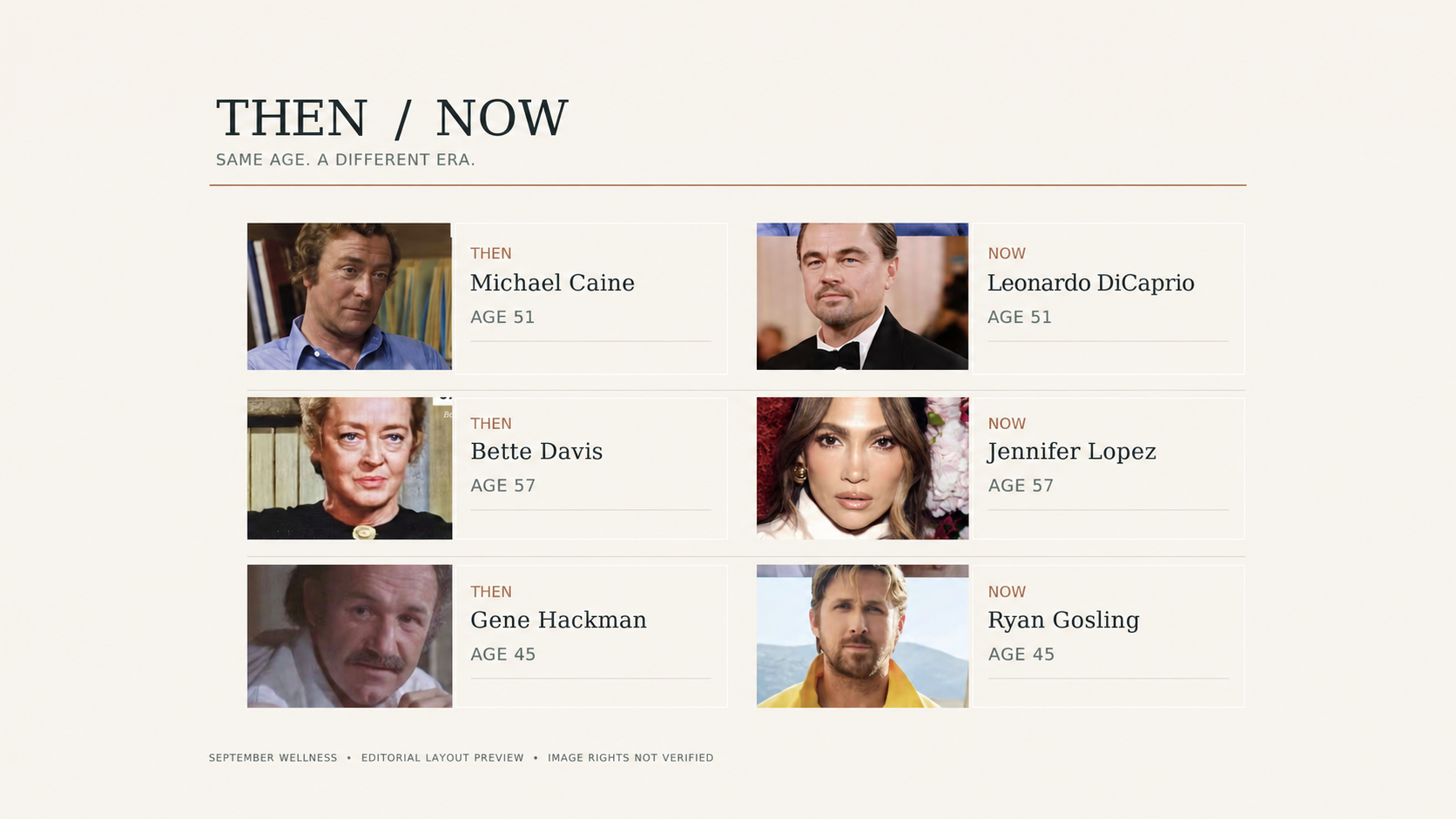
It was one of those side by side comparisons of celebrities at the exact same age, decades apart. Michael Caine at 51 next to Leonardo DiCaprio at 51. Bette Davis at 57 next to Jennifer Lopez at 57. Gene Hackman at 45 next to Ryan Gosling at 45.
The difference was startling. Not because the older celebrities looked bad. They didn’t. They just looked like grown ups. Proper, established, middle aged adults who paid their mortgages on time, knew their insurance agent by first name and owned very sensible luggage.
The people photographed today? Some of them look like they haven’t decided what they want to be when they grow up.
Here’s my favorite example. When The Golden Girls premiered in 1985, Rue McClanahan, who played the gloriously flirty Blanche, was 51 years old. Fifty one! Picture Blanche’s shoulder pads, the floral caftans, the wicker furniture. Now picture a 51 year old woman you know today. It’s practically a different species.
I’m 52. And when I look around at my friends, I genuinely think we look younger than people our age did when we were growing up. Is it because we dress younger? Take better care of ourselves? Get a little help from Botox and lasers? Or is something actually different about how we’re aging?
Turns out, it’s a little bit of everything.
And buried in the research is one deeply uncomfortable discovery: we may look younger on the outside, but some scientists are finding evidence that newer generations could be aging faster on the inside.
Which feels like a particularly cruel joke after all the money we’ve spent on skincare.
First, Those Celebrity Comparisons Are Playing Tricks on You
Let’s start with the obvious. Comparing two celebrities at the same age is not exactly a controlled scientific experiment.
One photo might be a grainy screenshot from a 1983 talk show. The other might come from a movie premiere with professional lighting, professional makeup, a tailored tuxedo and a photographer whose entire job is making famous people look fabulous. We don’t know what treatments either person had, how much retouching happened, or how they’d look standing side by side in the fluorescent light of a grocery store.
And then there’s who gets picked. Jennifer Lopez is not the average 57 year old woman. Neither was Bette Davis. If you go hunting for the most dramatic comparisons, you’ll find them. That’s how a viral TikTok carousel works.
But I don’t think it’s all an illusion. Part of what we’re seeing has to do with how our brains decide how old someone is.
Apparently, Hairstyles Have Birthdays
Look at a photo of someone in their 50s from the 1980s. The hair is enormous. The makeup is unmistakably of its era. The clothes have structure. Sometimes shoulder pads big enough to qualify as protective sports equipment.
And somehow, all of that makes them look older to us.
Here’s why that’s fascinating. When we were kids, those were the hairstyles and clothes worn by adults: our parents, our teachers, the anchors on the evening news. So our brains learned to file those looks under “old.” Now we see that same perm on someone who was 45 in an old photo, and our brain reads them as 65. It’s not necessarily their face. It’s the whole package.
Meanwhile, a 55 year old today might have long, loose hair, jeans, sneakers and the exact same haircut as her 30 year old daughter. We’ve mostly stopped following the old rules about how a middle aged person is supposed to look.
I can’t remember the last time someone told me a woman over 50 shouldn’t wear her hair long. And if they did, I’d have a few suggestions about what they could do with that opinion.
A hairstyle can’t reverse biological aging, of course. But it can completely change how old we think someone is. So some of those viral comparisons are showing us changing fashion as much as changing faces.
The Cigarette Smoke We Forget Was Everywhere
Now for something that genuinely changed: smoking.
In 1965, 42.4 percent of American adults smoked cigarettes. By 2022, that had dropped to 11.6 percent, according to the CDC. That’s an enormous shift. And cigarettes don’t just wreck your lungs and heart. They wreck your face.
Researchers have studied this using identical twins, which is a brilliant setup: two people with nearly identical genes, but different exposure to one major aging factor. In a 2013 study of 79 pairs of identical twins where one smoked more than the other, the smoking twins showed noticeably more aging around the eyes and mouth. Smoking damages skin through oxidative stress and by breaking down the collagen and elastin that keep it firm and bouncy.
Unlike the hairstyle theory, this isn’t about seeming older. It’s actual damage.
So when we compare a 55 year old from 1985 with a 55 year old today, we may also be comparing two generations with very different lifetime exposure to cigarette smoke. Not every older celebrity smoked, and plenty of people still do today. But it’s a huge population level change that almost never comes up in those TikToks. Back then, you couldn’t even sit on an airplane without breathing someone else’s Marlboro.
We Also Used to Cook Ourselves in the Sun
I remember when having a tan was practically a personality trait. We went to the beach with baby oil, not sunscreen. Some people used aluminum foil reflectors to make sure no ray went to waste. The goal was to look like you’d spent the entire summer on a yacht. And if you burned first? That was just part of the process.
Today we’re having serious conversations about SPF 50, UVA protection, mineral versus chemical filters, and whether our sunscreen was formulated in Korea or reformulated for the American market. It’s a whole new world.
And unlike a lot of skincare claims, the evidence that sunscreen prevents visible aging is unusually strong. In a randomized Australian trial published in 2013, researchers followed adults for four and a half years. One group used sunscreen every day. The other used it whenever they felt like it. The daily sunscreen group had 24 percent less skin aging according to the researchers’ measurements. That’s a real result from a controlled study, not a before and after photo in an ad.
The catch: sunscreen you start wearing at 52 can’t erase 30 years of baby oil and beach towels. Prevention and reversal are two very different things. But if younger generations protect their skin earlier, there’s a solid biological reason to expect less sun damage at the same age. That’s a real change in how skin ages, not just in how it’s photographed.
Botox Changed the Rules. Then Everything Else Joined the Party.
Now for the part everyone’s thinking about but nobody wants to say too loudly: cosmetic treatments.
Facial aging changed dramatically once wrinkle relaxing injections went mainstream. Then came fillers. Lasers. Radiofrequency. Microneedling. Chemical peels. Prescription retinoids. Better facelifts. Better eyelid surgery. Hair transplants. Veneers. The list is getting ridiculous.
According to the American Society of Plastic Surgeons, about 28.2 million minimally invasive procedures were reported in the United States in 2024. That includes everything from injectables and skin treatments to certain other nonsurgical services. And that’s procedures, not people. Plenty of folks come back for more.
Whatever way you look at it, the business of changing how we look has become enormous.
And these treatments do very different things. Botox temporarily relaxes the muscles that create certain lines. Fillers add volume and reshape contours. Resurfacing treatments improve texture and sun spots. Retinoids help with cell turnover and collagen. Surgery repositions tissue. And a great dentist can change the way your entire face looks.
That’s not one anti aging technology. It’s an entire industry devoted to editing the features we associate with age.
But here’s the important part: making a face look younger isn’t the same as making the body underneath biologically younger. If Botox softens the lines around your eyes, that’s a visible improvement. It doesn’t mean your arteries, immune system or kidneys just got younger too.
That doesn’t make cosmetic treatments silly or dishonest. If someone wants to look fresher, feel more confident or simply enjoy what they see in the mirror, I’m all for it. I just think we should be clear about what we’re buying. Sometimes we’re repairing damage. Sometimes we’re reshaping structure. And sometimes we’re just becoming extraordinarily good at hiding the evidence.
Why Two People Can Age Completely Differently
Here’s where the science gets really interesting. Even people born on the same day with the same genes can end up looking surprisingly different.
A 2009 study of identical twins found that smoking and sun exposure were linked to older looking faces, no surprise there. But it also found something unexpected: among twins over 40, the one with a higher body weight sometimes looked younger.
Before anyone celebrates by canceling their gym membership, the explanation is simple. A little facial fullness softens wrinkles and hollows. Lose a lot of facial fat in midlife, and your cheekbones may look fabulous while the rest of your face suddenly looks exhausted. There’s a reason the old saying goes that after a certain age, you have to choose between your face and your figure.
It’s a balance between body composition, facial volume, skin elasticity and the bone structure underneath. Genes matter enormously. But they’re not the whole story. A Danish study of more than 1,800 older twins found that lifestyle and social factors were linked to how old people looked to others.
The face we see at 55 is the result of far more than the number of candles on the cake.
Menopause Changed the Conversation for Women
When we compare women across generations, there’s one more piece we can’t skip: hormones.
Estrogen plays a big role in skin thickness, hydration, collagen and elasticity. As it drops around menopause, many women notice their skin changing faster than it did in their 30s and early 40s. It gets drier. Fine lines get louder. Skin can feel thinner and less resilient. And the facial fullness that once kept everything comfortably lifted starts to shift.
It’s not your imagination.
But it’s worth separating what we know from what the skincare industry would like us to believe. Yes, hormones affect skin. No, that doesn’t mean every woman needs a $200 “menopause” face cream. Researchers are studying hormone related approaches to skin aging, but whether a specific treatment is safe and effective depends on the formula, the dose, how it’s used and your personal medical history. Hormone therapy is never a casual cosmetic shortcut.
What has changed is the conversation. Our mothers mostly suffered through menopausal skin changes in silence. Today, women in their 40s and 50s are walking into their doctor’s offices with detailed, sophisticated questions.
And frankly, it’s about time.
Are We Even Comparing the Same 55 Year Old?
Here’s what bugs me most about these celebrity comparisons. We’re comparing famous people from different decades, under different expectations, and then acting like their faces represent millions of regular people.
They don’t.
Money matters. Healthcare matters. Diet, work, stress and environment matter. Someone who spent decades working outdoors without sun protection has had a very different life than someone who works in an office and sees a dermatologist twice a year. And someone with money for great dental care, preventive medicine, a personal trainer and regular treatments has advantages that aren’t available to everyone.
There’s also a selection problem. We notice the celebrities who look unusually young. Nobody makes a viral carousel of perfectly ordinary celebrities who look exactly their age. So the internet keeps showing us the exceptions until we start believing they’re normal.
Remember that the next time someone announces that 60 is the new 40. Maybe for some people. But I suspect it depends rather heavily on your genes, your bank account, your health and how flattering the lighting is.
Now for the Rude Part: What If We’re Aging Faster on the Inside?
This is the finding that completely changed how I wanted to write this article.
In June 2026, researchers published a study in Nature Medicine looking at biological aging across generations. They analyzed data from more than 154,000 people in the UK Biobank, plus a separate group of Americans. Instead of wrinkles or gray hair, they looked at blood and health markers tied to how fast the body is actually aging.
And they found something unexpected. People born in more recent decades tended to have worse biological aging scores than people born earlier, even after accounting for their actual age.
In one comparison, people born between 1965 and 1974, which is my generation, scored 23 percent higher on a standardized measure of biological aging than people born between 1950 and 1954.
Before anyone starts checking their expiration date, that doesn’t mean we’re 23 percent older on the inside. It’s a statistical measure, not actual years added to our bodies. But the researchers also found that higher biological aging scores were linked to increased risks of certain cancers diagnosed before age 50.
So here’s the picture. On the outside, we’re armed with sunscreen, lasers, injectables and ten step skincare routines, looking younger than any generation before us. On the inside, researchers are seeing signs that some of us may be experiencing more biological wear and tear.
The study was observational, so it can’t prove that every system in the body is aging faster or explain exactly why. And biological aging clocks are useful research tools, not perfect measurements of how old your whole body really is.
Still, the contrast is striking. We may be getting better at looking younger without actually becoming younger. And that raises a question the beauty industry rarely wants to discuss: what exactly are we trying to slow down?
Your Face and Your Body Don’t Always Agree
We tend to think of aging as one big process. You get older, your skin wrinkles, your hair goes gray, your joints complain, and eventually you start making little noises every time you stand up.
But aging isn’t nearly that coordinated. Different organs and tissues age at different speeds. Your skin might show plenty of sun damage while the rest of you is in excellent health. Someone else might have flawless skin and serious heart or blood sugar problems. And a person who looks older than their age might be strong, active and thriving.
There is research linking how old a face looks with certain health outcomes. But your face is not a medical test. You cannot look at a celebrity photo and know how their arteries are doing, let alone how long they’ll live.
That’s why the whole “looking young” conversation can be a little misleading. We’ve turned a youthful appearance into shorthand for wellness. Great skin? Must be healthy. Toned body? Must be aging beautifully. Looks 40 at 60? Must have found the secret.
That’s just not how biology works. And the better our cosmetic tools get, the less useful our appearance becomes as a clue to our actual health. Which is wonderful if your goal is to look good. Less wonderful if you start confusing your reflection with a full medical report.
So Who’s Aging Better, Us or Our Parents?
I don’t think there’s one simple answer.
In some ways, we have real advantages. Far fewer of us smoke. We understand sun protection. We have treatments for visible aging that didn’t exist decades ago. Dental care, dermatology, cancer screening and cosmetic techniques have all improved enormously.
But some of the difference is purely cultural. Hairstyles changed. Clothes changed. Our expectations of what 50, 60 and 70 should look like changed. And today’s photos are picked, styled and edited in ways that make fair comparisons nearly impossible.
Then there’s that new biological aging research, which pokes a hole in the idea that modern life has improved every part of getting older.
So no, I don’t think we can confidently say today’s 55 year olds are aging better than their parents across the board. But we’ve made dramatic progress in managing how aging looks. And maybe that’s the real story.
The Part I Actually Find Encouraging
I don’t actually want to look 35 again. I liked 35. I just don’t need a repeat.
What I love is that turning 50 no longer comes with a mandatory rulebook. You don’t have to cut your hair short. You don’t have to stop wearing jeans. You don’t have to give up fitness, fashion, dating, travel, adventure or anything else that lights you up.
You can do skincare because you enjoy it. You can get Botox if you want. You can skip all of it. And none of those choices decides whether you’re aging well.
To me, that’s the most meaningful change of all. Maybe the goal isn’t to look younger than our parents did at 55. Maybe it’s having the freedom to decide for ourselves what getting older is supposed to look like.
Blanche Devereaux would approve.
THE SEPTEMBER TAKE
I’m still obsessed with those celebrity comparisons. And I’m not going to pretend I don’t enjoy that today’s 50 year olds seem younger than the ones I grew up with.
But after digging into the research, I think we’ve gotten remarkably good at changing how aging looks, while scientists are still figuring out what’s happening underneath.
I’d love to look wonderful at 75. But I’d also like my heart, brain, bones and everything else to be doing reasonably well when I get there.
Looking younger is lovely. Actually aging well is the bigger accomplishment.
And if I can pull off both? I’m certainly not going to complain.
Do This Week
1. Find an old photo of someone at your age.
A parent, an aunt, an uncle, or even yourself years ago. Look past the wrinkles and notice the clothes, the hair, the makeup and the photography. How much of what reads as “older” is actually just a different decade?
2. Take sunscreen seriously.
Of everything marketed to prevent visible aging, daily sun protection has some of the best evidence behind it. Use a broad spectrum sunscreen every day, and remember that shade, hats and protective clothing count too.
3. Keep your skincare grounded in evidence.
Before adding another expensive product, ask what it’s supposed to do and whether real human studies back it up. Prescription retinoids, for example, have far more evidence for sun damage than most trendy ingredients.
4. Don’t confuse cosmetic wins with health wins.
Enjoying skincare or cosmetic treatments is great. Just remember that fewer wrinkles tell you nothing about your blood pressure, cholesterol or blood sugar.
5. Rethink what “looking your age” means.
Long hair at 60? Wonderful. Jeans at 75? Why not? There’s no biological reason to adopt a certain style just because you had another birthday.
6. Take care of the parts nobody sees.
Exercise, good nutrition, avoiding tobacco, regular checkups and managing your health risks aren’t as exciting as a laser treatment. But they matter enormously for how you’ll feel at 75.
7. Stop using celebrities as your aging benchmark.
Enjoy the photos. Be curious. But a professionally styled red carpet portrait is never a fair comparison with your bathroom mirror.
The goal isn’t to look like somebody else at 55. It’s to take care of the person you’re going to be at 75.
September Wellness provides educational information about skin aging, cosmetic treatments and longevity research. Visible appearance is not a reliable measure of overall biological age or health. Cosmetic procedures and prescription skincare treatments involve individual benefits, limitations and risks. Consult qualified healthcare professionals for personalized advice about skin treatments, cancer prevention and age-related health concerns.
Sources & Further Reading
1. Hughes, M. C. B., Williams, G. M., Baker, P., and Green, A. C. Sunscreen and Prevention of Skin Aging: A Randomized Trial. Annals of Internal Medicine, 2013. The Australian study finding that daily sunscreen use reduced measured skin aging by 24 percent over four and a half years.
2. Okada, H. C., Alleyne, B., Varghai, K., et al. Facial Changes Caused by Smoking: A Comparison Between Smoking and Nonsmoking Identical Twins. Plastic and Reconstructive Surgery, 2013. Uses identical twins to show how differences in smoking exposure are associated with visible facial aging.
3. Guyuron, B., Rowe, D. J., Weinfeld, A. B., et al. Factors Contributing to the Facial Aging of Identical Twins. Plastic and Reconstructive Surgery, 2009. Examines how smoking, sun exposure, body weight and other lifestyle factors relate to differences in facial aging between twins.
4. Rexbye, H., Petersen, I., Johansens, M., et al. Influence of Environmental Factors on Facial Ageing. Age and Ageing, 2006. A study of more than 1,800 older twins examining environmental and lifestyle factors associated with how old people appear.
5. Centers for Disease Control and Prevention. Notes From the Field: Tobacco Product Use Among Adults — United States, 2017–2023. MMWR, 2025. Documents changes in tobacco use, providing context for the dramatic decline in cigarette smoking since the 1960s.
6. American Society of Plastic Surgeons. 2024 ASPS Procedural Statistics Release. Plastic and Reconstructive Surgery, 2025. Provides national estimates of cosmetic surgical and minimally invasive procedures, showing how much aesthetic medicine has grown.
7. Tian, R., et al. Biological Aging and Generational Shifts in Early-Onset Cancer Risk. Nature Medicine, 2026. Examines biological-aging measurements across birth cohorts and their associations with certain early-onset cancers. The findings complicate the assumption that looking younger necessarily means aging more slowly.
8. Dart, A. Accelerated Ageing Confers Early-Onset Cancer Risk. Nature Reviews Cancer, 2026. Explains the newer biological-aging research and what the findings may mean for understanding early-onset cancer risk.