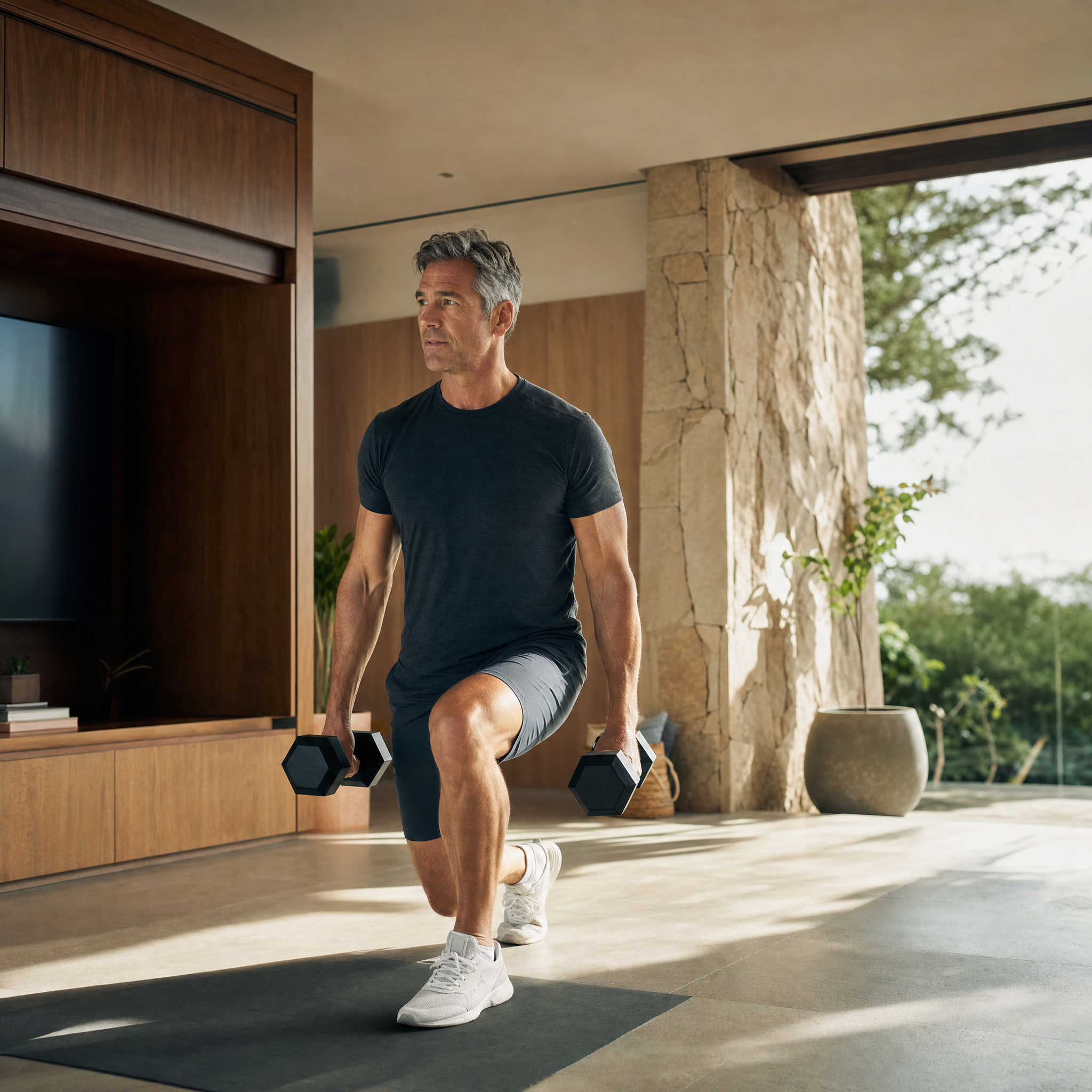
There’s a particularly annoying moment in adulthood when you realize the things that used to work still technically work. They just don’t seem to work quite the same way.
Maybe you’ve been doing roughly the same workouts for years. Maybe you walk, take classes, run, lift weights or cycle through periods of being very good about exercising and periods when life gets in the way.
Then somewhere along the line, the return on your effort changed.
The workout that used to tighten things up in a few weeks doesn’t quite do it anymore. A hard session can leave you sore for three days instead of one. You can be active and still notice muscle disappearing from places where you’d very much prefer to keep it.
It’s tempting to assume the answer is simply to work harder.
It probably isn’t.
Your body hasn’t stopped responding to exercise. But some of the things we’re trying to accomplish with exercise become different as we move through our 40s, 50s and 60s.
Which means the workout doesn’t necessarily need to get harder.
It needs to get smarter.
What actually changes as we get older?
Your body doesn’t suddenly become incapable of building muscle or getting fitter because you crossed an invisible birthday line. But several things do begin working against you, and some start earlier than most of us realize.
One of the biggest is muscle.
Adults gradually lose muscle mass and strength as they age, particularly if they aren’t doing anything specifically to preserve it. Hormonal changes, lower activity levels, illness, nutrition and changes within the muscle itself can all contribute. Women have the added transition of menopause, while men tend to experience a more gradual hormonal shift.
But there’s another piece that matters: older muscle can become somewhat less responsive to the same signals that once encouraged it to grow and repair. Researchers sometimes call this anabolic resistance.
In normal language, it means your body may need a clearer reason to hang on to muscle than it did when you were younger.
That changes the purpose of exercise.
At 25, you might have exercised mainly because you wanted to be thinner, look better in jeans or train for a race.
At 55, those things are still perfectly legitimate goals. But now exercise is quietly doing another job in the background. You’re giving your body a reason to maintain muscle, strength, bone, balance, cardiovascular fitness and the physical capacity you’ll want ten, twenty and thirty years from now.
This isn’t about preparing to become old.
It’s about making sure the version of you who still wants to travel, carry luggage, ski, garden, play pickleball, get up off the floor, move furniture or chase a grandchild around someday actually has the body to do it.
And that requires a slightly different assignment.
More exercise isn’t necessarily better exercise
When something stops working the way it used to, our instinct is often to do more of it.
Walk farther. Add another class. Stay on the treadmill longer. Cut another rest day. Burn more calories.
But the goal now isn’t simply to accumulate as much exercise as possible. It’s to make sure the exercise you’re doing is giving your body the signals it actually needs.
Cardiovascular exercise still matters enormously. Walking, hiking, cycling, swimming, running and other aerobic activities support cardiovascular health, metabolic health, endurance and a long list of things we care about.
But being active and being strong are not quite the same thing.
You can walk five miles a day and still gradually lose muscle. You can have excellent cardiovascular fitness without giving your muscles enough resistance to maintain their strength. And you can spend a lot of time exercising without doing much to challenge the parts of your body that are most likely to decline with age.
That’s where resistance training starts to become less of a fitness hobby and more of a long-term health strategy.
The basic idea is wonderfully uncomplicated: muscles adapt when we ask them to do something that is sufficiently difficult.
That could mean dumbbells. Machines. Resistance bands. Body-weight exercises. A barbell. A well-designed class. You do not have to develop an emotional attachment to a squat rack.
What matters is that the muscles are actually being challenged and that the challenge gradually progresses as you become stronger.
That last part is easy to miss.
If you’ve been lifting the same five-pound dumbbells for three years and they no longer feel particularly difficult, your body has gotten very good at doing exactly what you’ve asked of it.
That’s an accomplishment.
It’s also probably time to ask for a little more.
The goal isn’t to destroy yourself in a workout
Somewhere along the way, we picked up the idea that a workout only really counts if it leaves us sweaty, exhausted or sore enough to think about it every time we sit down the next day.
That’s not how adaptation works.
Exercise is a stress on the body. The workout provides the stimulus, but much of the actual adaptation happens afterward, while you recover.
And recovery can change with age.
That doesn’t mean everyone over 50 suddenly needs three days on the sofa after exercising. Plenty of people in their 50s and 60s train hard and recover extremely well. Training history, sleep, nutrition, stress, health and the type of exercise all matter.
But if you’ve noticed that a workout you once bounced back from overnight now seems to follow you around for another day or two, you’re not necessarily imagining it.
The answer isn’t to stop challenging yourself. It’s to stop treating exhaustion as the measure of whether the workout worked.
For resistance training in particular, consistency matters far more than occasionally doing so much that you need several days before you’re willing to do it again.
You want enough resistance to challenge the muscle. Enough recovery to adapt to that challenge. Then another appropriate challenge.
Repeat.
That is a much less dramatic formula than “no pain, no gain.”
It’s also considerably easier to keep doing for the next 30 years.
And that may be the most important distinction of all. At this stage, we aren’t looking for the workout plan you can tolerate for six punishing weeks.
We’re building a body you intend to keep using.
THE SEPTEMBER TAKE
Your body isn’t asking you to stop pushing it. It may just be asking for a different kind of push. As we get older, exercise becomes less about how many calories we can burn or how exhausted we can make ourselves and more about preserving the things we don’t want to lose: muscle, strength, mobility, endurance and independence. You can still train hard. Just make sure “hard” is actually accomplishing something.
Strength is only part of the assignment
If resistance training were the entire answer, this would be a very short article.
It isn’t.
A body that ages well needs several different abilities, and they don’t all come from the same kind of exercise.
You need strength, but you also need cardiovascular fitness. You need enough mobility to move comfortably through useful ranges of motion. You need balance and coordination. And you need enough everyday movement that exercise isn’t the only time your body leaves a chair.
This is where workout advice can become unnecessarily complicated. Suddenly there are heart-rate zones, step counts, mobility routines, strength splits, interval sessions and an impressive number of people telling you that their particular method is the one you’ve been missing.
You probably don’t need to optimize every minute.
For most people, a much more useful question is whether their week contains a reasonable mix of the things the body needs.
The current U.S. physical activity guidelines recommend that adults accumulate at least 150 minutes of moderate-intensity aerobic activity each week, or 75 minutes of vigorous activity, along with muscle-strengthening activity on at least two days. Adults benefit from moving more and sitting less, and as balance becomes more relevant, activities that challenge it belong in the picture too.
Those are population-level guidelines, not a personalized workout prescription. But they give us a useful framework.
Walk because walking is excellent for you.
Do cardio because your heart and lungs need training too.
Lift something challenging because your muscles need a reason to stay.
Move your joints through useful ranges because you want to keep using those ranges.
Practice balance before losing your balance becomes the reason you start thinking about it.
None of this requires turning your life into one long fitness project.
It requires covering the bases.
And once you stop expecting one kind of exercise to accomplish everything, building a useful week becomes much simpler.
What if you’re starting from almost nothing?
This is the part that gets lost when fitness advice is written by people whose normal Tuesday involves a 6 a.m. workout and a protein shake.
A lot of adults aren’t trying to fine-tune an already impressive training program. They’re trying to start one.
Maybe exercise disappeared somewhere between work, kids, caregiving, injuries and life. Maybe you walk but haven’t done anything resembling strength training in years. Maybe you’ve never particularly liked exercising and have no intention of making it your personality now.
That’s okay.
You do not need to go from zero to five workouts a week for exercise to start helping you.
If you currently do very little, adding two short strength sessions and walking more regularly is a meaningful change. If twenty minutes is what fits into your life, twenty minutes counts. If you need to begin with body-weight exercises or lighter resistance while you learn the movements, that counts too.
The important part is that “starting gently” doesn’t quietly become “never progressing.”
As your body adapts, something needs to become a little more challenging. Maybe the weight gets heavier. Maybe you add a repetition. Maybe an exercise becomes more difficult. Maybe you walk farther or faster.
Progress doesn’t have to be dramatic.
It just has to exist.
And there’s a psychological advantage to this approach that doesn’t get enough attention: you get to become stronger before you start thinking of yourself as someone who exercises.
You don’t need the identity first.
You can let the evidence convince you.
You may need to eat differently too
Exercise doesn’t happen in isolation. If the goal is to preserve or build muscle, your body also needs the raw materials to do it.
Protein becomes particularly interesting here.
Research suggests that older adults may benefit from paying more attention not only to total protein intake, but also to getting meaningful amounts of high-quality protein across the day. That doesn’t mean everyone needs to start weighing chicken breasts or carrying a shaker bottle.
It does mean the old strategy of coffee for breakfast, something small at lunch and most of the day’s protein arriving with dinner may not be doing muscle any favors.
Energy intake matters too.
If you’re trying to lose weight, it can be tempting to combine a large calorie deficit with a lot of exercise and assume that more effort will produce a better result. But weight loss can include loss of lean tissue along with fat, particularly when resistance training and adequate protein aren’t part of the plan.
That becomes increasingly relevant when muscle is something we’re actively trying to preserve.
The goal isn’t simply to make the number on the scale smaller.
Ideally, we want to improve body composition while keeping as much useful tissue as possible.
This is one reason the conversation around exercise, protein and weight loss is changing, especially as GLP-1 medications become more common. Losing substantial weight without thinking about muscle is a very different proposition at 55 than it may have seemed at 25.
We’re going to spend much more time on protein, creatine, body composition and GLP-1-related muscle loss elsewhere on September Wellness.
For now, the important point is simple:
You can’t ask your body to build and preserve tissue while consistently forgetting to give it the materials to do the job.
The assignment changed. That doesn’t mean the fun is over.
There’s an unfortunate way we sometimes talk about exercise in midlife, as though everything from here forward is an elaborate attempt to slow down the inevitable.
Preserve your muscle. Protect your bones. Prevent falls. Maintain mobility.
All important.
Also not particularly inspiring.
There’s another way to look at it.
Getting stronger now means you can do more things later. Better cardiovascular fitness means a steep hike on vacation feels like an adventure instead of an ordeal. Maintaining muscle makes everyday life easier. Better balance and mobility give you more confidence in what your body can do.
The goal isn’t merely to avoid becoming frail.
It’s to maintain as much physical freedom as possible.
And you may be surprised by how adaptable your body still is. Studies of adults well beyond middle age consistently show that muscle and strength can improve with resistance training. You haven’t missed some biological deadline because you didn’t start lifting weights at 30.
You can start at 45.
Or 55.
Or 65.
The details may change. Recovery may deserve more respect. Protein may deserve more attention. Strength training may need to move higher on the priority list.
But your body is still listening.
So if the workout routine that served you for the last twenty years suddenly seems to be producing less than it used to, you don’t necessarily need to abandon exercise or double down on punishment.
Change the assignment.
Train for strength. Train your heart. Keep moving. Recover well. Eat enough of what your body needs. Make the program challenging enough to create change and realistic enough that you’ll still be doing some version of it years from now.
Because the best workout for this stage of life isn’t the one that proves how hard you can work today.
It’s the one that helps you keep doing everything else you want to do tomorrow.
Sources & Further Reading
U.S. Department of Health and Human Services. Physical Activity Guidelines for Americans, 2nd Edition.
Federal guidance on aerobic activity, strength training, movement and balance.
Kristiansen J.B., Vissing K., Nielsen J.L. Age-related anabolic resistance and post-absorptive muscle protein synthesis: integrative evidence from a systematic review and meta-analysis. Frontiers in Physiology, 2026.
A recent systematic review examining how muscle protein synthesis changes with age and how older muscle responds to food and exercise.
Marzetti E., et al. Lower extremity muscle hypertrophy in response to resistance training in older adults: Systematic review, meta-analysis, and meta-regression of randomized controlled trials. Experimental Gerontology, 2025.
A review finding that resistance training can produce measurable muscle growth in adults 65 and older.
Buskard A.N.L., Petrella R.J. Resistance Training and Weight Loss in Older Adults: A Scoping Review. Sports Medicine – Open, 2023.
Examines resistance training, body composition and why changes in lean and fat mass can matter more than scale weight alone.
Wright C.S., et al. Nutrition and Exercise Interventions to Improve Body Composition for Persons with Overweight or Obesity Near Retirement Age: A Systematic Review and Network Meta-Analysis of Randomized Controlled Trials. Advances in Nutrition, 2023.
Examines calorie restriction, protein intake and different forms of exercise, including their effects on muscle preservation during weight loss.