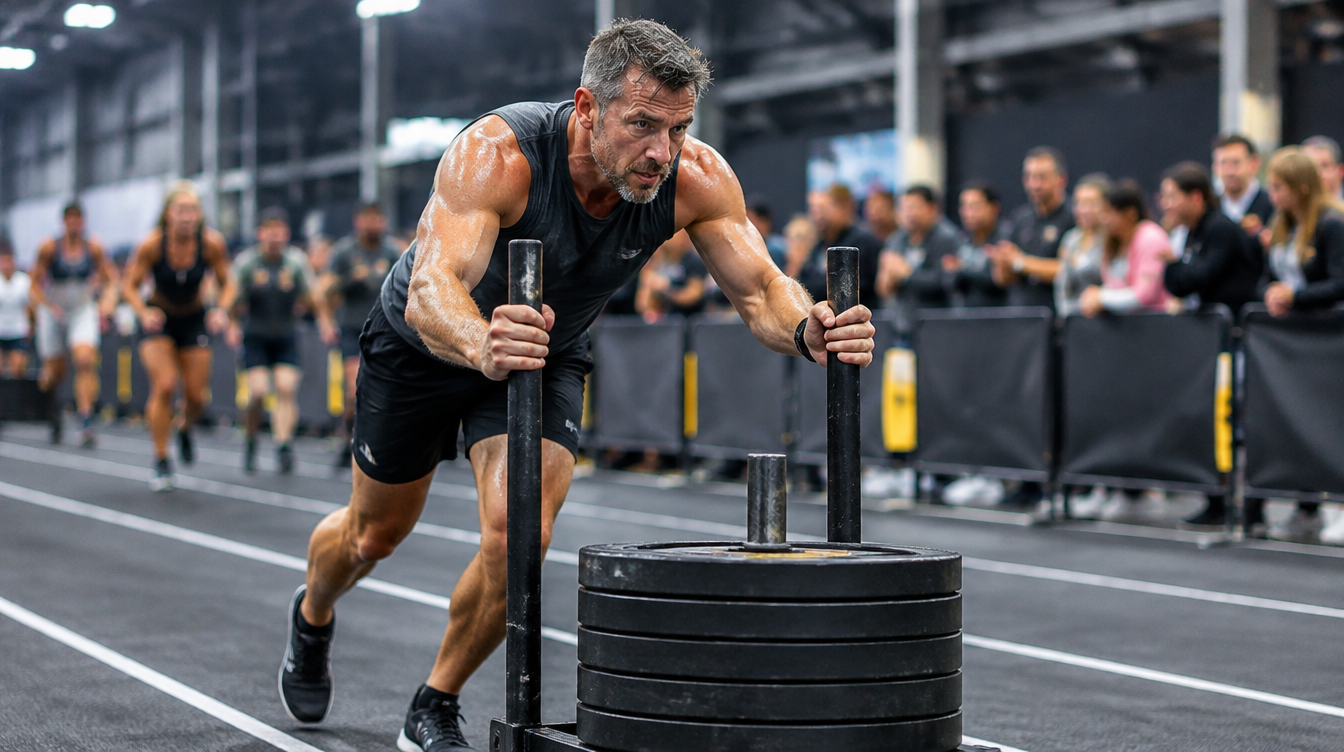
Eight kilometers of running. Eight brutal workout stations. Registration spots that vanish in minutes. And a growing crowd of adults who apparently never got the memo that their competitive years were supposed to be over.
The first time HYROX landed on my radar, it was because my son signed up for a competition.
The second time was considerably less conventional.
In September 2026, an elite competitor at a HYROX race in Beijing had a rather unfortunate bout of diarrhea mid-race. She kept going, won, and the footage became an international news story, complete with fierce debates over sportsmanship, hygiene and just how far someone should push to finish a race.
And TikTok, in its infinite wisdom, decided this was exactly the subject I needed to learn more about. For days afterward, my FYP was wall to wall HYROX: training videos, race clips, commentary and people shoving enormous weighted sleds across gym floors. What started with one very memorable incident had turned into a full blown cultural phenomenon on my phone.
Suddenly I was hearing about registration spots selling out almost instantly, and people genuinely furious they couldn’t get a ticket to an event that involves voluntarily running five miles while doing exercises most of us would prefer to do a lot less of.
And then came the detail that really got my attention: people in their 50s and 60s are doing it too.
I love seeing people our age push themselves. I have friends who are extremely fit and would probably find this whole thing exhilarating. Personally, my body is far more accustomed to Pilates than to dragging a weighted sled across a convention center. Neither one is better. They’re just very different ways to move.
But I was curious. What turned HYROX into such an obsession? And why are people competing for the privilege of competing?
First, What Exactly Is HYROX?
Think of HYROX as a gym workout that escaped the gym, bought a stopwatch, booked a convention center and started selling tickets.
It’s an indoor fitness race created in Germany, and the format barely changes from one event to the next. You run one kilometer, complete a workout station, then repeat the whole thing eight times. That’s eight kilometers of running, about five miles, interrupted by eight physical challenges.
The stations, in order: a 1,000 meter SkiErg, a weighted sled push, a sled pull, 80 meters of burpee broad jumps, a 1,000 meter row, 200 meters of farmer’s carries, 100 meters of sandbag lunges and, finally, 100 wall balls. If that last one is new to you, picture squatting over and over while hurling a weighted medicine ball at a target above your head. A lovely way to end an already exhausting afternoon.
It’s not CrossFit, though the two share plenty of DNA. CrossFit throws a huge variety of workouts and competition formats at you, often involving technical lifts and gymnastics. HYROX is predictable. You know the eight stations, the order and the distances before you even sign up. The weights change by division, but the structure stays the same.
That’s a bigger deal than it sounds. Because everyone runs essentially the same course, you can compare your time not just with the person next to you, but with someone racing in another city or country. And with your own time from the last race. For a certain kind of person, that’s catnip.
This Is More Than an Instagram Fad
HYROX may feel like it appeared overnight, but it’s actually been around since 2017. Its recent growth, though, is hard to ignore.
According to ClassPass’s 2025 global fitness report, searches for HYROX classes jumped 506 percent and reservations rose 432 percent in a single year. Those are numbers from one booking platform, not the whole industry, and big percentages can come from a small starting point. Still, that’s remarkable for a workout most people hadn’t heard of a few years ago.
And it’s not just people booking classes. A 2026 study analyzed race data from more than 275,000 HYROX participants, which tells you how big the competitive side has become. In some cities, popular race categories sell out almost the moment they’re released. The stories of people setting alarms, refreshing their screens and getting genuinely upset when they miss out sound less like signing up for a fitness event and more like trying to get Taylor Swift tickets.
Except instead of spending two hours enjoying a performance, you spend over an hour being the performance.
So what’s behind all this enthusiasm?
Apparently We Want Our Workouts to Have a Finish Line
For decades, the gym deal was simple. You paid for a membership, showed up when you could, worked out and hopefully noticed some improvement over time. Maybe you lifted more, ran faster or liked how your jeans fit. For most of us, the payoff was private.
HYROX changes that. Suddenly there’s an event on the calendar, a measurable goal, a group of people training for the same challenge, a race day atmosphere, official results and something to talk about afterward. You’re not just working out anymore. You’re training for something.
I suspect that’s a huge part of the appeal. The fitness industry has spent years selling us on looking better. HYROX sells something different: the chance to accomplish something genuinely hard. There’s a big psychological difference between exercising because you feel you should and training because you’re excited about a goal.
None of this is entirely new. Runners have had marathon culture for decades, and CrossFit has long thrived on competition. But HYROX has packaged it into something standardized, highly visible and easy to explain. You don’t have to describe a whole season of ever-changing workouts when someone asks what you’re training for. Eight runs, eight stations, finish as fast as you can. Simple concept. Wildly difficult execution.
Yes, People Over 50 Are Doing It
This is the part that hooked me.
HYROX has official age groups for 45 to 49, 50 to 54, 55 to 59, 60 to 64 and beyond, with divisions stretching past 70. That doesn’t mean those groups are equally crowded. Younger adults still make up much of the field, and there aren’t solid worldwide numbers for how many racers are over 50.
But older competitors are clearly part of the sport, not a novelty act. A small 2025 study of 80 HYROX athletes included people in their late 40s, 50s and 60s. And a 2026 study following 89 HYROX athletes found that 18 percent were 50 or older. Neither is a global census, so don’t treat those percentages as gospel. But they show researchers are studying a sport with a real range of ages.
The more interesting question isn’t how many people over 50 are doing it. It’s why.
For years, fitness advice for midlife adults has revolved around keeping muscle, protecting bone density, preventing falls and staying independent. All important. All about as thrilling as a reminder to floss. There’s a big difference between being told to exercise so you can still carry your own groceries at 80 and deciding you’d like to enter a punishing competition at 55. One is about preventing loss. The other is about chasing achievement.
Not everyone wants their fitness goals to be about slowing down aging. Some people would rather find out what they can still do.
The Part Nobody Expected: It Feels Like a Community
Here’s what struck me most as I fell further down the rabbit hole. Watch enough HYROX footage, and the thing you notice isn’t the sleds or the stopwatches. It’s the people.
Strangers cheering for each other. Training partners hugging at the finish. Doubles teams of two friends, a married couple, a parent and an adult kid, grinding through the stations together. Relay teams of coworkers or gym buddies who clearly signed up as much for the fun of doing it together as for the race itself. And plenty of the loudest cheers seem to go not to the elite racers, but to the people simply determined to finish.
That matters, especially after 50. If you read our piece on friendship, you’ll remember the research showing that adult friendships are built on repeated time together, often doing a shared activity. HYROX delivers that almost by design: weekly training classes with the same faces, a shared goal on the calendar and a race day that gives everyone something to celebrate together.
It also helps explain why so many older adults seem to feel at home here, rather than out of place. Everyone runs the same course. A 58 year old and a 28 year old are doing the exact same eight stations, often side by side, often in the same wave. Age groups mean you’re racing people your own age for the results, but you’re sharing the floor, the sweat and the misery with everyone. There’s something wonderfully leveling about watching someone half your age struggle through the same wall balls you’re struggling through.
And for people in midlife, who may have lost some of the built-in community that came with raising kids or going to an office, joining a group that greets you by name and expects you on Tuesday nights can mean more than any finishing time.
Is every HYROX gym a warm, welcoming utopia? Of course not, and competitive cultures can sometimes tip into intimidating. But the community piece may be one of the most underrated reasons the sport is catching on, and one of the healthiest things about it.
Is HYROX the New Midlife Marathon?
The comparison to marathons and triathlons is obvious. Plenty of people in their 40s, 50s and 60s have been running marathons, cycling centuries and racing triathlons for years. HYROX didn’t invent ambitious exercise for older adults.
What it may have done is create a new on-ramp for people who like a mix of strength and endurance instead of specializing in one. You don’t have to be a marathoner, though you do need enough running fitness to handle five miles with brutal exercises in between. And unlike an Ironman, which demands serious swimming, cycling and running endurance, HYROX’s moves are recognizable from most gyms. That doesn’t make it easy. It just makes the challenge easier to picture.
There are also different ways to take part. In a singles race, you do every run and every station yourself. In doubles, two people run together and split the station work. Relays divide the race among a team. Those options make it more approachable, especially if you love training with friends or want a team experience. But even the “easier” formats require real preparation. This is not a casual Saturday Pilates class with an unusually enthusiastic instructor. It’s an athletic event.
What Does the Research Say About Training This Hard?
Here’s where a little perspective helps. HYROX combines several types of exercise with well established benefits: cardio, strength training, muscular endurance and coordination. Those can absolutely improve heart health, strength and your ability to handle demanding real-life tasks.
But that doesn’t mean science has crowned HYROX uniquely amazing for people over 50. Research on HYROX as a sport is still very new. A 2026 study followed 89 athletes for 12 weeks to look at injuries and other health problems. Researchers reported an overall injury incidence of 14.4 injuries per 1,000 training hours and stressed that much more research is needed to understand injury rates and risk factors. The study’s limitations mean we should be cautious about comparing that figure directly with injury rates in other sports.
That’s an important caveat. It’s tempting to assume a workout must be extra good for us because it’s extra hard. But intensity and benefit aren’t the same thing. The right amount and type of exercise depends on your fitness history, health, mobility, goals and ability to recover.
For someone who’s spent years running, lifting and training consistently, HYROX might be the perfect next challenge. For someone who’s been mostly sedentary, jumping straight into a race is an entirely different story. And age alone doesn’t decide it. A well conditioned 62 year old runner may be far better prepared than an out of shape 35 year old.
The question isn’t just how old you are. It’s what your body has been prepared to do.
Then There’s the Question of When to Stop
I can’t write about HYROX without circling back to the incident that set my TikTok on fire.
After the September 2026 Beijing race, HYROX acknowledged that officials should have stopped the competitor once the incident created a hygiene risk. The athlete later apologized, voluntarily withdrew her result and forfeited her points.
But beyond the headlines, the incident raised a genuinely interesting question about the culture of high-intensity competition: at what point does perseverance become a refusal to admit something has gone wrong?
We celebrate athletes for pushing through discomfort, finishing despite exhaustion and refusing to quit. Those can be admirable qualities. But knowing when to stop is its own kind of good judgment. And honestly, that’s a lesson that applies far beyond sports, and maybe one that comes a little more easily with age.
Sometimes the most impressive thing a capable person can do is recognize that continuing isn’t the smart move.
The Pilates Body and the HYROX Body Are Both Doing Just Fine
One thing I don’t love about fitness trends is the way every new one gets framed as a battle against everything that came before it. Strength training beats cardio! Pilates beats weightlifting! Walking is underrated! Running is overrated! And now, apparently, you haven’t truly exercised unless someone timed you pushing a sled.
I’m not buying it.
I happen to love Pilates. I appreciate the control, the precision, the flexibility and the strength it takes. I know what my body enjoys and what I’ll actually keep doing. Other people my age genuinely love competitive running, heavy lifting, cycling, swimming or punishing hybrid events like HYROX. Neither of us needs to win an argument about whose workout is superior.
Different activities build different things. Pilates can improve strength, flexibility, balance and body control. HYROX-style training places far bigger demands on sustained endurance, heavy carries and the ability to keep working while completely exhausted. Depending on your goals, both deserve a place in an active life. And neither one is a complete fitness program on its own. If you love Pilates, you may still benefit from extra cardio and progressive strength training. If you’re training for HYROX, recovery, mobility and proper strength prep matter enormously.
What matters most is finding something that challenges you appropriately, supports your health and is enjoyable enough that you’ll actually stick with it.
A Pilates body isn’t a failed HYROX body. It’s a body doing something different. And there’s plenty of room in the world for both.
Is HYROX Truly Accessible, or Just Good at Looking That Way?
HYROX markets itself as fitness racing for everyone, not just elite athletes. And there’s real appeal in familiar exercises, clear formats and multiple ways to take part.
But let’s be honest about the difference between being allowed to register and being ready to race. Running five miles while grinding through serious strength endurance work is no small thing, especially if you’ve never trained for that combination. Some stations mean moving a lot of weight. Others test coordination, balance and your ability to keep good form while exhausted. The physical demands don’t disappear just because you entered a recreational division.
Then there’s the cost. Registration fees vary by event, and on top of that, people often spend on specialized classes, coaching, travel, gear and hotels. For many, HYROX isn’t just a workout anymore. It’s a hobby, a social identity, a competitive pursuit and sometimes a destination vacation. Which may explain exactly why it’s caught on. People aren’t just paying to exercise. They’re paying to belong to something.
If you’re curious, especially after 50, the smart move is to try a beginner friendly HYROX training class first, learn the movements, build your running gradually and see how your body responds. There’s no glory in discovering halfway through a race that your enthusiasm was in far better shape than your knees.
Maybe the Appeal Isn’t Really About Fitness
The more I dug into HYROX, the more I suspected its popularity tells us something bigger than exercise.
So much of adult life is repetitive. We work, juggle responsibilities, take care of family, pay bills, go to appointments and try to squeeze in a workout with whatever time is left. For a lot of us, fitness becomes one more chore on the list.
A race flips that psychology. There’s a date, a challenge, a community, the chance to beat your personal best and a finish line waiting at the end. And, crucially, a reason to feel proud of something that has absolutely nothing to do with your job, your family obligations or how well you’re managing everyone else’s needs.
That may be especially appealing in midlife. At a stage when so much of the conversation is about what we’re losing with age, here’s a chance to work toward something new. You don’t have to be the fastest person in the room. You just have to be a little faster, stronger or more capable than you were last time.
That’s a pretty irresistible pitch, even for someone who plans to keep doing Pilates and cheering on the highlights from a very comfortable distance.
THE SEPTEMBER TAKE
HYROX didn’t reinvent exercise. It reinvented what exercise can feel like. A workout becomes a competition, a training plan becomes a goal, and a room full of strangers becomes a community.
I love that adults in their 50s and 60s are part of it. I also love that not everyone needs to be.
The point of staying fit after 50 isn’t to prove we can still perform like we’re 25. It’s to discover what we’re capable of now, and maybe find our people along the way.
And if your idea of a satisfying Saturday involves Pilates instead of a weighted sled, that’s a perfectly respectable finish line too.
Do This Week
1. Watch a HYROX race before deciding what you think.
A few minutes of real race footage explains the format better than any description. Watch the running between stations, and the people cheering, not just the dramatic sled clips.
2. Ask yourself whether you’d enjoy training toward a goal.
You don’t need a race to benefit from a goal. A faster walking pace, a longer hike, a heavier lift or better balance can be just as motivating.
3. Look at what your current routine actually builds.
Are you challenging your heart? Your strength? Your balance and mobility? Different activities offer different benefits, and a little variety can fill the gaps.
4. Curious about HYROX? Start with a class, not a race entry.
Find a coach who knows the format and can assess your experience, teach the movements and help you build up gradually. A race is something to prepare for, not a substitute for preparing.
5. Find your people, whatever the workout.
A running club, a Pilates studio, a walking group or a HYROX doubles partner: shared goals and familiar faces make it far more likely you’ll keep showing up.
6. Don’t let enthusiasm outrun recovery.
When you add demanding exercise, give yourself time to progress and recover. Persistent pain, unusual breathlessness, dizziness or other worrying symptoms mean stop and check in with a medical professional.
7. Give yourself permission to prefer something else.
A trend can be impressive without becoming your personal obligation. If walking, swimming, dancing, Pilates or anything else keeps you moving consistently, you never need to apologize for not wanting a race bib.
And one last thought: if you do decide to sign up for HYROX, I hope you have an absolute blast. I’ll be cheering for you. Probably right after my Pilates class.
September Wellness provides educational information about exercise, fitness trends, physical performance and healthy aging. This article is not individualized medical advice or a personalized training program. HYROX and other high-intensity competitions involve substantial cardiovascular and musculoskeletal demands. Individuals with underlying health conditions, injuries, symptoms or significant changes in activity level should consult an appropriate healthcare professional and qualified exercise specialist before beginning demanding training. Participation and injury risks vary.
Sources & Further Reading
1. HYROX. The Fitness Race. HYROX, official race information. Explains the standardized race format, eight exercise stations, running distances and differences among competition divisions.
2. HYROX. HYROX Singles Rulebook, 2025–2026 Season. HYROX, 2025. Provides official competition rules, age categories, exercise standards and division requirements, including the age groups for older competitors.
3. ClassPass. 2025 ClassPass Look Back Report. ClassPass, December 2025. Documents the surge in HYROX-related searches and class reservations, while showing how social and competition-based activities are influencing fitness participation.
4. Fernández-Navarrete, I., Ruiz-Alias, S. A., Gómez-García, M., et al. HYROX: A Descriptive Analysis of Participation Trends Among Over 275,000 Athletes in the New Fitness Modality. Research Quarterly for Exercise and Sport, 2026. Examines large-scale participation and performance trends in HYROX, providing a broader research perspective than individual competitions or social-media anecdotes.
5. Fernández-Navarrete, I., et al. Characterization of the Profile of HYROX Athletes. Applied Sciences, 2025. Examines the characteristics and training backgrounds of a small group of HYROX participants, including older competitors. Its findings should not be treated as a worldwide demographic breakdown.
6. Frontiers in Sports and Active Living. Prevalence, Burden and Risk Markers of Health Problems in HYROX Athletes: A 12-Week Prospective Cohort Study. Frontiers in Sports and Active Living, 2026. Follows 89 HYROX athletes over 12 weeks, examining injuries, training exposure and health problems. Highlights the need for more research on injury risks in this growing sport.
7. Cox, A. Australian HYROX Athlete Joanna Wietrzyk Apologises for Soiling Herself Mid-Race. ABC News, September 2026. Documents the Beijing competition incident, the athlete’s apology and withdrawal of her result, and the subsequent discussion about safety and race procedures.