One tidies up the factory floor inside your cells. The other sends text messages from it. Here’s why that difference is one of the most interesting stories in aging science right now.
Here’s a number that might change how you think about your body.
By some estimates, every single day, your cells produce and recycle roughly your own body weight in ATP, the tiny energy molecule that powers everything you do: blinking, breathing, walking to the fridge, reading this sentence.
You don’t make all that energy in one place. You make much of it in trillions of microscopic structures called mitochondria, scattered throughout nearly every cell you have. Some cells, like heart and muscle cells, are packed with thousands of them.
You probably remember mitochondria as “the powerhouse of the cell.” That’s the one biology fact almost everyone remembers. But it turns out it’s only half the story.
Two peptides, SS-31 and MOTS-c, have become fascinating to researchers precisely because they reveal the other half.
Meet Your Mitochondria (They Have a Weird Backstory)
Before we get to the peptides, you need to know something slightly mind-bending.
Scientists believe mitochondria were once free-living bacteria. More than a billion years ago, an ancient bacterium became part of another cell, and instead of being digested, it stayed. Over evolutionary time, the two developed a partnership: the bacterium got a safe home, and the host cell gained a spectacular energy supply.
That partnership worked so well that mitochondria are now found in nearly every cell of every animal on Earth, including you.
And mitochondria still carry reminders of their past life:
- They have their own DNA, separate from the DNA in the rest of your cell.
- That DNA is almost always passed down from your mother. Your mitochondria are, quite literally, a maternal inheritance.
- Their inner walls contain a special fat called cardiolipin, which is otherwise found predominantly in bacteria. Think of it as an old family heirloom they never threw out.
Hold on to two of those facts, the cardiolipin and the mitochondrial DNA. Each one is the key to one of our two peptides.
Think of a Mitochondrion as a Tiny Factory
Here’s the easiest way to picture what’s happening.
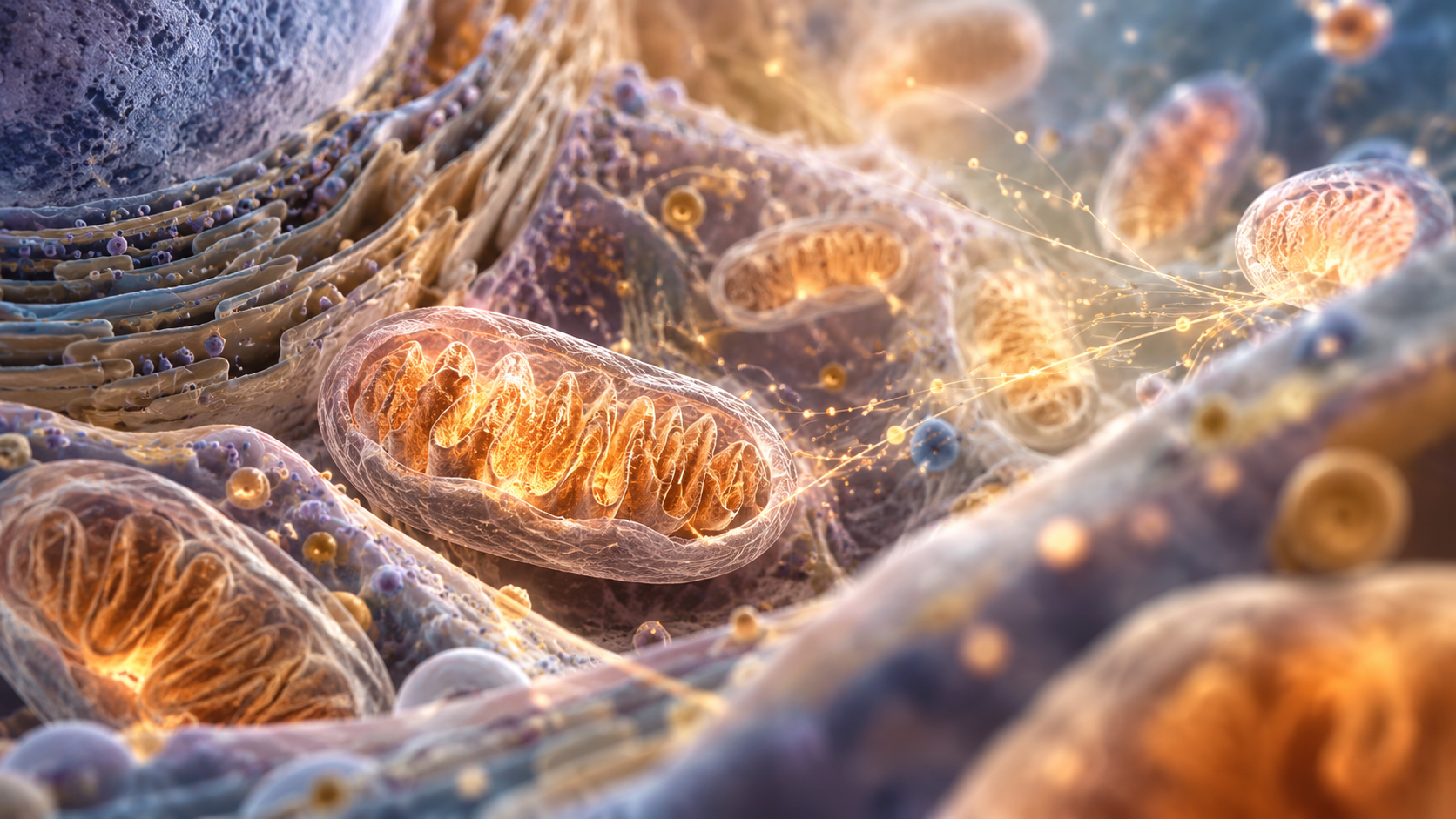
Imagine each mitochondrion as a small factory. Inside, there’s a factory floor with an assembly line of machines that work together to produce energy. For that line to run smoothly, everything has to be in the right place, organized and connected.
But a good factory needs more than machines. It also needs communication: someone who notices when supplies are running low or demand suddenly spikes, and tells the rest of the company what’s going on.
That’s the difference between our two peptides in a nutshell:
- SS-31 is about the factory floor.
- MOTS-c is about the messages.
Let’s take them one at a time.
SS-31: The Factory Floor Organizer
Remember cardiolipin, that heirloom fat? It lines the inner walls of the mitochondrial factory, the folded surface where the energy assembly line sits. Cardiolipin is a bit like the shelving and floor markings that help keep the machinery organized and working together.
When cardiolipin gets damaged (by oxidation, a sort of cellular rust) or disorganized, the assembly line can become less efficient. The machinery may not work together as effectively, energy production can be disrupted, and the factory may produce more exhaust: reactive molecules that, in excess, can cause damage. A little exhaust is normal and even useful as a signal. Too much is a problem.
SS-31, also called elamipretide, was designed to target that factory floor. It’s a tiny peptide, just four amino acids long, that associates with mitochondrial membranes, especially cardiolipin-rich areas. Research suggests it may help support the environment in which the machinery operates, influence mitochondrial function, and keep excessive oxidative stress in check.
A fun bit of trivia: the “SS” comes from the surnames of the scientists associated with its development, Hazel Szeto and Peter Schiller. Not every molecule gets named after its parents, but this one did.
The Milestone: A First-Ever Treatment
In September 2025, the FDA granted accelerated approval to elamipretide, sold as Forzinity, for eligible people with Barth syndrome, a rare inherited disease. It’s the first treatment ever approved for the condition.
Here’s what makes that so satisfying scientifically. Barth syndrome is, at its core, a cardiolipin disease. A genetic mutation disrupts how the body processes cardiolipin, and the “factory floors” in heart and muscle cells don’t work as they should. Only a small number of people in the U.S. live with it.
So a molecule designed to interact with cardiolipin got approved for a disease of cardiolipin. The FDA even officially describes Forzinity as a “mitochondrial cardiolipin binder.” In science, that’s about as tidy as a story gets.
The approval came from a clinical program involving just 12 patients, reflecting how rare the disease is. Although the initial randomized trial didn’t meet its primary walking-distance and fatigue endpoints, improvements in muscle strength observed during longer-term follow-up contributed to the accelerated approval. A confirmatory trial is required to verify clinical benefit.
Why This Doesn’t Make It an “Energy Shot”
This is where it’s easy to get carried away, so let’s be clear.
Approval for one rare disease doesn’t mean SS-31 has been shown to boost energy or slow aging in healthy people. In fact, in a larger trial of 218 people with a different mitochondrial condition, it didn’t significantly improve walking distance or fatigue.
That result is worth paying attention to, because “mitochondrial problems” aren’t all the same problem. A tool built for one specific kind of breakdown may not help with another. It’s like having the perfect wrench for one bolt; it doesn’t fix the whole car.
MOTS-c: The Messenger
Now for the second peptide, and a genuinely surprising discovery.
For decades, scientists thought of mitochondria largely as obedient workers. The cell’s main control center, the nucleus, gave orders, and the mitochondria followed them.
Then researchers found that mitochondrial DNA (that maternal inheritance) can also encode small messenger molecules. In other words, the factory doesn’t just take orders. It sends messages back to headquarters.
MOTS-c, first described in 2015, is one of those messages. It’s a small, naturally occurring peptide, 16 amino acids long, encoded by instructions in your mitochondrial DNA. (Its full name is mitochondrial open reading frame of the 12S rRNA-c. You will never need to say that out loud. We promise.)
What Does It Say?
Think of MOTS-c as the factory sending a text: “Heads up, energy is running tight down here.”
It appears to participate in how cells respond to metabolic stress, like when fuel is low or demand suddenly spikes. Research links it to a system called AMPK, which acts like your cell’s fuel gauge. When energy availability changes, AMPK helps the cell adjust by coordinating fuel use, glucose metabolism, and other responses to the challenge.
And here’s the detail that really got scientists’ attention: under certain stressful conditions, MOTS-c has been observed in experiments traveling into the nucleus itself, the cell’s headquarters, where it participates in regulating genes involved in adaptation. It’s less like a text and more like an employee walking straight into the CEO’s office.
The Exercise Connection
This is where MOTS-c gets especially intriguing for the rest of us.
Exercise is, in a way, a deliberate energy crunch. When you take a brisk walk, lift something heavy or climb stairs, your muscles suddenly need more fuel than usual, and that challenge is part of what tells your body to adapt and get stronger.
Researchers found that MOTS-c levels in human muscle increased dramatically after exercise. In a small study involving 10 healthy young men, muscle MOTS-c levels rose approximately 12-fold following a cycling session. Circulating levels increased much more modestly. And in a 2021 study, older mice given MOTS-c performed better physically, running longer on treadmills than untreated mice.
That raises a tantalizing question: is MOTS-c part of how exercise works its magic?
Possibly. But here’s the important distinction: much of what we know about administering MOTS-c comes from cell and animal studies. We still lack convincing human clinical trials demonstrating that taking MOTS-c improves strength, endurance or healthy aging. It’s an exciting chapter of science that’s still being written, and it certainly isn’t a replacement for actually going on that walk.
Why This Matters as We Get Older
As we age, our mitochondria tend to change. In some people the factories become fewer, less organized or less responsive. Inactivity, illness and diet all play a role.
That helps explain part of something you’ve probably noticed: two people the same age can have wildly different energy and physical ability. One 65-year-old is hiking mountains; another gets winded carrying in the groceries. Of course, muscle strength, cardiovascular health and medical conditions matter too, but mitochondrial function is one piece of that larger picture.
Researchers are interested in SS-31 and MOTS-c because each offers a window into a different part of what goes wrong, and maybe what could go right:
- SS-31 asks: what if the factory floor itself is the problem?
- MOTS-c asks: what if the problem is the factory’s ability to sound the alarm and adapt?
Neither has been shown to reverse aging. But together, they’re moving science beyond the simple idea that aging cells just need “more energy.” They may also need well-organized factories, clear communication and the ability to adapt.
The Quick Comparison
| SS-31 (elamipretide) | MOTS-c | |
|---|---|---|
| Its job, in one line | Supports mitochondrial membrane function | Participates in metabolic stress signaling |
| Where it comes from | Made in a lab | Naturally occurring, encoded by mitochondrial DNA |
| Size | 4 amino acids | 16 amino acids |
| What it works with | Cardiolipin (the “heirloom” fat) | Metabolic signaling pathways, including AMPK |
| Human evidence | Several clinical trials, mixed results | Limited human research; much evidence is preclinical |
| FDA status | Accelerated approval for eligible Barth syndrome patients | Not approved for any therapeutic use |
| Proven to slow aging? | No | No |
The big takeaway: these aren’t two versions of the same thing. One has already crossed into real-world medicine for a specific disease. The other is earlier in its journey, which is exactly what makes it so interesting to follow.
Could They Work Better Together?
This is where things get especially interesting. If SS-31 helps support the mitochondrial machinery while MOTS-c participates in the signals that tell cells how to respond to metabolic demands, could the two approaches complement each other?
There’s a compelling biological logic to the question. After all, even a beautifully organized factory needs a good communication system, and excellent communication can only accomplish so much if the machinery itself isn’t functioning properly. Both structure and signaling matter, particularly as we age and our cells face changing energy demands.
Researchers increasingly recognize that complex biological problems rarely involve just one pathway. That’s part of what makes the possibility of studying SS-31 and MOTS-c together appealing. Rather than thinking of them as competing mitochondrial peptides, it may be more useful to think of them as two different approaches to understanding the same complicated system.
Of course, complementary mechanisms don’t automatically guarantee complementary results. We don’t yet have convincing human clinical evidence showing that administering SS-31 and MOTS-c together improves mitochondrial function, exercise performance or healthy aging, and the safety of combining them hasn’t been established.
But that doesn’t make the idea any less scientifically interesting. The possibility that supporting mitochondrial membrane function and metabolic signaling together could offer advantages is a reasonable hypothesis worth investigating. Whether those advantages actually materialize is a question for future research, and one worth watching.
A Word on Safety
Elamipretide has been studied in people and approved for one condition, so its safety profile is much better understood. The most common side effects include reactions where it’s injected, such as redness, itching or swelling. Its prescribing information also identifies precautions involving hypersensitivity and severe kidney impairment. Still, what’s known from patients with a specific disease doesn’t automatically apply to healthy people using it for other reasons.
MOTS-c has more unanswered questions. Your body makes it naturally, but that doesn’t tell us what happens when it’s administered from outside the body, repeatedly or over the long term. Appropriate human dosing, long-term effects and interactions with medications remain insufficiently established. “Natural” and “proven” aren’t the same thing, and both are worth respecting.
THE SEPTEMBER TAKE
For most of us, mitochondria were one line in a biology textbook: the powerhouse of the cell.
SS-31 and MOTS-c show us how much bigger that story really is. Your mitochondria are ancient partners with their own DNA, inherited from your mother. They run carefully organized factory floors, and they talk back, sending messages that may help your body adapt to stress and exercise.
SS-31 has already reached a real-world medical milestone, while MOTS-c is opening intriguing new research possibilities. Their different mechanisms even raise interesting questions about whether they might someday complement each other.
Neither is a fountain of youth. But together, they’re helping scientists ask much more interesting questions about energy and aging.
Do This Week
1. Give your mitochondria a “message” to send.
A brisk 20-minute walk, a few flights of stairs or some bodyweight squats all create the kind of mild energy challenge that tells your cells to adapt. That’s the very process MOTS-c researchers are studying.
2. Notice your energy patterns.
When do you feel most energized, and when do you crash? Sleep, movement and meals all affect how your body manages energy, even if those everyday patterns can’t tell you exactly how your mitochondria are functioning.
3. Read past the “energy boost” headlines.
Next time you see a product promising to “recharge your mitochondria,” ask: which part of the mitochondria, and what’s the actual evidence? You now know more than most of the people writing those ads.
This article is for educational purposes. It discusses published research and is not a recommendation to use experimental peptides or to treat any medical condition without qualified medical supervision.
Sources & Further Reading
- U.S. Food and Drug Administration. Drug Trials Snapshots: Forzinity (elamipretide). FDA, 2025. Official information about the clinical evidence and safety findings supporting elamipretide’s accelerated approval.
- U.S. Food and Drug Administration. FDA Grants Accelerated Approval to First Treatment for Barth Syndrome. FDA, September 2025. Explains the approval and the specific disease for which elamipretide is authorized.
- Karaa A, et al. Efficacy and Safety of Elamipretide in Individuals With Primary Mitochondrial Myopathy: The MMPOWER-3 Randomized Clinical Trial. Neurology, 2023. A large randomized study that did not demonstrate significant improvements in its primary walking-distance and fatigue outcomes.
- Lee C, et al. The mitochondrial-derived peptide MOTS-c promotes metabolic homeostasis and reduces obesity and insulin resistance. Cell Metabolism, 2015. Foundational research identifying MOTS-c and investigating its role in metabolic regulation.
- Reynolds JC, et al. MOTS-c is an exercise-induced mitochondrial-encoded regulator of age-dependent physical decline and muscle homeostasis. Nature Communications, 2021. Research exploring MOTS-c responses to exercise in humans and physical performance in experimental mouse models.
- Wan W, et al. Mitochondria-derived peptide MOTS-c: effects and mechanisms related to stress, metabolism and aging. Journal of Translational Medicine, 2023. A review discussing the proposed mechanisms and emerging research surrounding MOTS-c.
- Merry TL, et al. Mitochondrial-derived peptides in energy metabolism. American Journal of Physiology–Endocrinology and Metabolism, 2020. An overview of mitochondrial-derived peptides and their potential roles in metabolic communication.