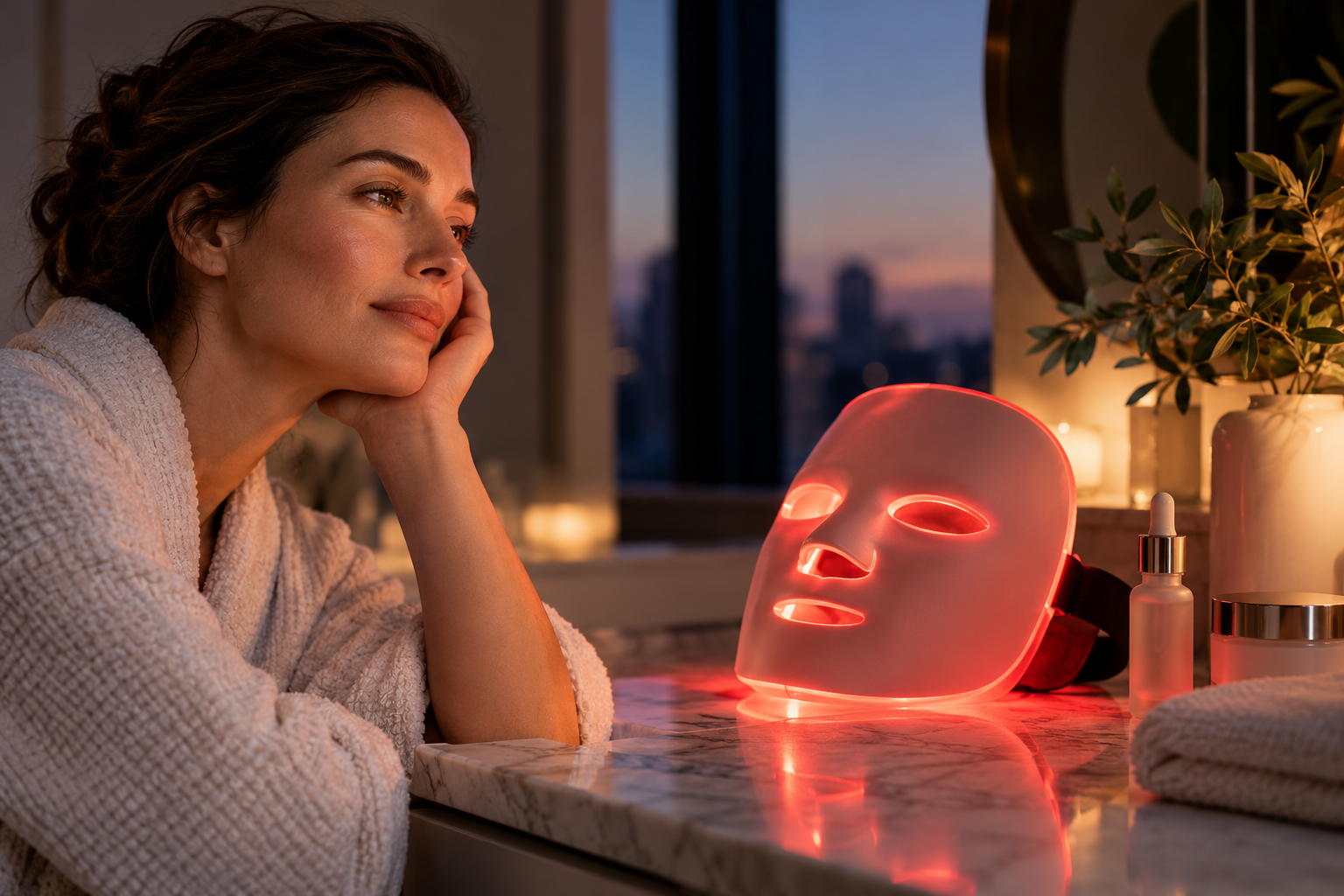
Red light masks promise smoother skin, more collagen and a complexion that apparently just needed better lighting. The science is more convincing than you might expect. Whether you need a glowing $500 mask in your bathroom is a different question entirely.
Somewhere along the way, skincare took a strange turn.
We went from washing our faces with a bar of soap, to layering twelve serums, to sitting on the sofa wearing what looks like a prop from a low-budget sci-fi movie.
The red light mask has arrived, and it is not subtle.
There’s something gloriously absurd about answering emails, watching Netflix or startling your spouse in the hallway while your face glows like a malfunctioning traffic light. Yet these devices have become fixtures in celebrity routines, dermatology offices and the ever-growing world of at-home wellness gadgets.
The promises are big: more collagen, fewer wrinkles, better texture, less inflammation, faster healing. A younger-looking face without needles, downtime, or explaining to anyone why your forehead suddenly doesn’t move.
So does any of it actually work?
Here’s the surprise: red light therapy has a lot more scientific credibility than most of the gadgets competing for space on your bathroom counter.
But there’s a big difference between “produces measurable biological effects” and “delivers the dramatic results in that beautifully lit ad.” That gap is where things get interesting.
It all started with a failed cancer experiment
Here’s an origin story most people have never heard.
In 1967, a Hungarian physician named Endre Mester wanted to know whether lasers could cause cancer. He shaved the backs of some mice and zapped them with a low-powered laser.
The mice didn’t get cancer. Instead, their hair grew back faster than in the mice that weren’t treated.
Mester had stumbled onto something remarkable: low-intensity light didn’t just pass through tissue harmlessly. It seemed to change how cells behaved. That accidental discovery launched an entire field of research.
Decades later, NASA gave the research another push. Scientists working with LEDs developed to grow plants in space noticed something unexpected: minor cuts and scrapes seemed to heal faster under the lights. That observation helped launch further research into using LEDs for wound healing.
So yes, the glowing mask on your nightstand has a family tree that includes a Hungarian laboratory and the space program. That’s a better pedigree than most skincare products can claim.
Your skin can respond to light without getting a tan
Most of us have a simple relationship with light and skin: sun causes tans, burns and, eventually, wrinkles. Wear sunscreen. Done.
So deliberately shining light on your face to improve it sounds a bit backwards.
The key is that not all light is created equal.
Sunlight contains ultraviolet (UV) rays, which damage DNA and drive skin cancer and aging. Red light therapy uses specific red and near-infrared wavelengths, with no UV involved.
Scientists call it photobiomodulation, a word that sounds like it belongs in a lab rather than next to your moisturizer. But the idea is simple: instead of burning, heating or injuring the skin to force it to repair itself, low-intensity light tries to nudge cells into working a little better.
That’s what makes it so different from many cosmetic treatments. A resurfacing laser often works by creating controlled damage, then letting the skin rebuild. Red light aims to influence how cells function without that damage.
Think of the difference between renovating your kitchen by ripping out all the cabinets versus giving your maintenance crew better tools and a cup of coffee. Both might improve the room. They are not the same project.
The mitochondria connection
Here’s where the story heads somewhere familiar to September Wellness readers: your mitochondria.
Inside your skin cells are those tiny energy factories we’ve talked about before. Researchers believe certain wavelengths of red and near-infrared light are absorbed by a mitochondrial enzyme called cytochrome c oxidase, a key part of the energy-production assembly line.
The leading theory is that this light may influence ATP (cellular energy), nitric oxide and reactive oxygen species, which in turn may change how cells handle stress, inflammation and repair.
Now, about those reactive oxygen species. In skincare ads, they’re always the villain, and antioxidants are the heroes riding in to save the day. But biology is rarely that tidy. In small, carefully controlled amounts, reactive oxygen species are actually useful signals your cells use to communicate. The dose and context matter.
To be clear, scientists still debate exactly which molecules are responsible and how consistently these pathways work in real human skin. The clinical improvements are sometimes easier to show than the complete explanation of how they happen.
That isn’t unusual in medicine. Plenty of treatments worked long before anyone fully understood why. But it does mean the idea that light can influence cell behavior is far more interesting than “your skin just likes being illuminated.”
So what does the research actually show?
Happily, this isn’t a topic supported only by before-and-after photos taken in suspiciously flattering bathroom lighting.
The 2007 Korean study. Researchers ran a controlled split-face trial in which 76 participants completed treatment with red light (633 nm), near-infrared light (830 nm), a combination, or a sham. Treatments were twice a week for four weeks.
The treated groups improved on objective measurements, with maximum improvements of about 36% in wrinkle measurements and 19% in elasticity compared with baseline.
Important context: those are the best results on specific measurements, not a 36% reduction in how old someone looks, and not what an average person should expect from a consumer mask.
What made this study especially convincing is that researchers looked beneath the surface. Tissue samples showed changes in collagen and elastic fibers, plus signs of more active fibroblasts, the cells that produce your skin’s structural framework. They weren’t just asking people whether they felt prettier.
The 2014 study. A larger trial of 136 volunteers compared different red and near-infrared exposures with untreated controls. Treated participants showed improvements in complexion, roughness and measured collagen density.
And here’s an interesting twist: a broader mix of light wavelengths didn’t clearly beat the red light alone. More kinds of light didn’t automatically mean better results.
Neither study was perfect. The devices differed from today’s home masks, the groups were modest in size, and long-term follow-up was limited. But together they made a key point: red light deserved to be taken seriously as a skin treatment, based on controlled experiments rather than Instagram glow.
The big question: do home masks actually work?
For years, the elephant in the room was whether results from powerful clinic devices could be reproduced with smaller, less powerful masks used at home. That’s a fair question when you’re about to spend hundreds of dollars on something that looks like a futuristic hockey mask.
A 2026 systematic review in Aesthetic Plastic Surgery examined eight studies involving 365 participants, focusing specifically on at-home LED devices for facial rejuvenation.
The good news: red and near-infrared home devices were linked to improvements in wrinkles, smoothness, elasticity and texture, and side effects were generally mild and temporary.
The fine print:
- The studies used different wavelengths, devices and schedules, with sessions ranging from a few minutes to much longer.
- Results were measured in different ways. Some studies showed improvement on one wrinkle measurement but not on broader rating scales.
- Diverse skin tones were poorly represented.
- There were few strong head-to-head comparisons between devices.
So the bottom line is: real improvements are possible, but not every mask works equally well, and the most expensive one isn’t automatically the best. In a market where sleek design and a premium price can easily pass for better science, that’s worth remembering.
Collagen isn’t something you switch on like a lamp
Most red light marketing centers on collagen, and that makes sense. Collagen gives skin its structure and firmness, and its slow decline contributes to fine lines and sagging.
Research suggests red light may encourage fibroblasts to boost collagen-related activity. That’s plausible and increasingly well studied.
But there’s a big gap between “encouraging some collagen activity” and “reversing decades of aging.”
Your skin doesn’t respond to light by instantly building a brand-new structural framework worthy of a luxury home. Collagen remodeling is slow, and how your skin looks depends on much more than collagen: pigmentation, hydration, sun damage, genetics, inflammation and more.
So let’s be clear about one popular claim: red light does not erase wrinkles the way the ads suggest. Realistic expectations are subtle improvements in fine lines, texture and overall glow, not dramatic lifting or deep wrinkles vanishing.
If a device promises a facelift without the inconvenience of an actual facelift, skepticism is the correct response.
The most overlooked secret: more light isn’t better
This rarely appears on the packaging, but it may be the most important thing to know.
With red light, dose matters enormously, and more isn’t always better. Researchers describe a biphasic dose response: the right amount of light may help, while significantly more may help less, or even backfire.
Think of watering a plant. Too little doesn’t help. But tripling the water doesn’t make it grow three times faster. At some point you’re just drowning the poor thing.
Several factors work together:
- Wavelength (the color of light)
- Irradiance (how much power reaches your skin)
- Duration (how long you use it)
- Distance (how far the light is from your face)
- Fluence (the total energy delivered)
That’s why two devices can both say “red light” and deliver completely different treatments. A mask resting on your face isn’t the same as a panel several feet away, and a brighter device isn’t automatically a better one.
Ten minutes of the right treatment can beat thirty minutes of too much.
So follow the device’s tested instructions. Don’t assume that if 10 minutes is good, an hour must be life-changing. (Skincare has always had a complicated relationship with “more is better.” Just ask anyone who’s ever used three exfoliating acids in one night.)
Decoding the wavelength numbers
Shop for a red light device and you’ll be greeted by numbers that look like satellite specs: 630. 633. 660. 830. 850.
Those are wavelengths, measured in nanometers (nm), and different wavelengths travel into the skin differently:
- Visible red light (about 630–660 nm) is mostly studied for skin appearance and surface-level effects.
- Near-infrared light (about 810–850 nm) is invisible to the eye and can reach somewhat deeper tissue.
There’s a sound biological reason to study both, and some trials combine them.
But here’s the trap: two wavelengths don’t make a device twice as effective. And benefits claimed for near-infrared in other settings don’t automatically apply to a consumer face mask.
The question that actually matters isn’t “Does that wavelength sound impressive?” It’s “Has this device, or a truly comparable treatment, been studied for the result I want?” Precise-sounding numbers are easy to print on a box. Clinical evidence is not.
What about acne and redness?
Wrinkles get most of the attention, but light is also being studied for acne and inflammation.
Acne research often involves blue light, which targets compounds produced by acne-causing bacteria, along with red light for its possible calming effect on inflammation. A 2025 review in JAMA Dermatology found encouraging evidence that at-home LED devices can reduce certain acne lesions.
But a device studied for pimples hasn’t proven it firms sagging skin, and light doesn’t work equally well for every type of acne. Deep cysts and nodules often need other treatment.
Skin tone matters too. People with deeper skin tones can be more prone to pigmentation changes from visible light, and not every device has been well tested across diverse skin. That’s especially important for anyone with melasma or stubborn dark spots.
The assumption that light treatment must be harmless because it doesn’t involve needles or peels is a little too convenient. Noninvasive doesn’t mean biologically inactive. And anything biologically active deserves some respect.
Is it safe to strap a glowing mask to your face?
For most healthy adults using a quality device as directed, red light therapy appears well tolerated in the short term. Side effects in studies are typically minor: temporary redness, warmth or mild irritation.
And unlike UV light, the red and near-infrared wavelengths used aren’t known to cause the DNA damage associated with sun exposure.
A few cautions:
- Long-term data on years of home use is still limited.
- Photosensitivity: If you have a light-sensitive condition or take medications that make you sensitive to light, check with a dermatologist first.
- Your eyes: Some devices require goggles, especially those using near-infrared. Follow the instructions rather than improvising.
A word about “FDA-cleared”
You’ll see “FDA-cleared” on a lot of boxes. It sounds like a scientific stamp of approval, but it isn’t. FDA clearance is a regulatory designation tied to a specific device and intended use, and it often focuses on safety and similarity to existing devices. It doesn’t prove the device delivers every dramatic result in the marketing.
The same goes for celebrity endorsements and price tags. An $800 mask isn’t automatically better than a $250 one. Sometimes you’re paying for better engineering, fit and quality control. Sometimes you’re paying for spectacular branding. The trick is figuring out which.
So is an expensive red light mask worth it?
Here’s where the science meets the bathroom counter.
Based on the evidence, red light therapy can be a reasonable addition to your routine if you’re after gradual improvements in fine lines, texture and overall glow.
But we’d think of it as a supporting player, not the star of the show. The headliners are still:
- Daily sunscreen, the single most proven anti-aging habit
- Retinoids, with decades of evidence for photoaging
- Good moisturizing and targeted treatment for your specific concerns
Red light may complement those. It doesn’t replace them.
There’s also the consistency problem. Unlike a serum you slap on in 30 seconds, light therapy usually means regular sessions over weeks or months. Even the most effective device won’t do much if it gets used three times, then retires to the closet next to the abandoned exercise bike.
So here’s our honest take:
It may be worth it if you enjoy the ritual, can comfortably afford it, understand its limits and will actually stick with it.
It’s probably not worth it if you’re stretching your budget because an ad promised to turn back the clock.
Your skin doesn’t get healthier just because your routine got more expensive. The best wellness tools aren’t the ones that look most impressive on the shelf. They’re the ones with real evidence, realistic benefits and a genuine chance of fitting into your life.
The most interesting thing about red light isn’t the wrinkles
There’s something genuinely fascinating about a treatment that tries to improve skin biology without cutting, burning or injuring it.
Red light represents a new way of thinking about skincare: not removing damage or slathering on ingredients, but using carefully chosen light to influence the body’s own repair signals. That has implications far beyond beauty, from wound healing to inflammation research.
But every use needs its own evidence. A result for facial wrinkles doesn’t prove anything about muscle recovery, joint pain, dementia or longevity, no matter how confidently those claims appear together on a product page.
For skin, the evidence is now strong enough to take seriously, and still too inconsistent to back every marketing promise.
And maybe that’s the most useful conclusion of all: red light doesn’t have to be a miracle to be worthwhile, and it doesn’t have to be nonsense just because the masks look ridiculous.
Somewhere in between is a treatment with real scientific promise, modest but measurable benefits, and a surprisingly complicated relationship between light and living tissue.
Not bad for something that makes you look like you’re about to phone home to another planet.
THE SEPTEMBER TAKE
Red light therapy has earned more scientific credibility than its sci-fi appearance suggests. It began with a 1967 experiment that accidentally made mice grow hair faster. Today, controlled studies show that carefully delivered red and near-infrared light can improve measures of wrinkles, texture and collagen. The results, though, are gradual, and not every device has been tested equally.
The real question isn’t whether red light can influence your skin. It can. It’s whether a specific device delivers enough benefit to justify its price, your time and the claims on the box.
A glowing mask may deserve a spot in your skincare routine. It just doesn’t deserve to be the most important thing in it.
Do this week
1. Check your foundation first.
Before buying a pricey light device, make sure the basics are covered: daily sunscreen and treatments matched to your real concerns. A mask can’t make up for skipping SPF.
2. Ask what the device has actually been tested for.
Look for studies on that specific device, or a truly comparable protocol, rather than general red light claims or impressive wavelength numbers.
3. Resist the urge to overdo it.
Follow the tested schedule, distance and eye-protection instructions. Longer sessions aren’t better sessions.
4. Set realistic expectations.
If you try it, look for gradual changes in texture, fine lines and glow over weeks to months, not a facelift by Friday.
5. Consider your skin’s needs.
If you have melasma, a photosensitivity condition, a history of unusual reactions to light, or take light-sensitizing medications, talk with a dermatologist before buying.
This article is intended for educational purposes and does not replace individualized dermatological or medical advice. Red light therapy devices differ in wavelength, intensity, treatment protocols and intended uses. Benefits and risks vary according to the device, skin condition, individual health and treatment approach. Consult a qualified healthcare professional before using light therapy if you have a photosensitivity condition, take photosensitizing medications or have other relevant medical concerns.
Sources & Further Reading
- Das RK, Thayer WP, Kubiak CA, et al. Efficacy and Safety of At-Home Light-Emitting Diode Photobiomodulation for Facial Rejuvenation: A Systematic Review. Aesthetic Plastic Surgery, 2026.
Eight studies, 365 participants; at-home LED devices for wrinkles, texture and elasticity. - Lee SY, Park KH, Choi JW, et al. A Prospective, Randomized, Placebo-Controlled, Double-Blinded, and Split-Face Clinical Study on LED Phototherapy for Skin Rejuvenation. Journal of Photochemistry and Photobiology B: Biology, 2007.
The 76-participant split-face trial with tissue-level collagen findings. - Wunsch A, Matuschka K. A Controlled Trial to Determine the Efficacy of Red and Near-Infrared Light Treatment in Patient Satisfaction, Reduction of Fine Lines, Wrinkles, Skin Roughness, and Intradermal Collagen Density Increase. Photomedicine and Laser Surgery, 2014.
The 136-volunteer randomized controlled trial. - Quirk BJ, Whelan HT. What Lies at the Heart of Photobiomodulation: Light, Cytochrome C Oxidase, and Nitric Oxide—Review of the Evidence. Photobiomodulation, Photomedicine, and Laser Surgery, 2020.
Why the mitochondrial mechanism is still debated. - Huang YY, Sharma SK, Carroll J, Hamblin MR. Biphasic Dose Response in Low Level Light Therapy—An Update. Dose-Response, 2011.
Why more light isn’t necessarily better. - Ershadi S, Barbieri JS. At-Home LED Devices for the Treatment of Acne Vulgaris: A Systematic Review and Meta-Analysis. JAMA Dermatology, 2025.
Evidence for at-home LED acne treatment. - American Academy of Dermatology Association. Is Red Light Therapy Right for Your Skin? Patient education resource, updated 2024.
Dermatologist guidance on results, safety and skin-tone considerations. - Mester A, Mester A. The History of Photobiomodulation: Endre Mester (1903–1984). Photomedicine and Laser Surgery, 2017.
Historical background on Endre Mester’s pioneering experiments and the origins of photobiomodulation.