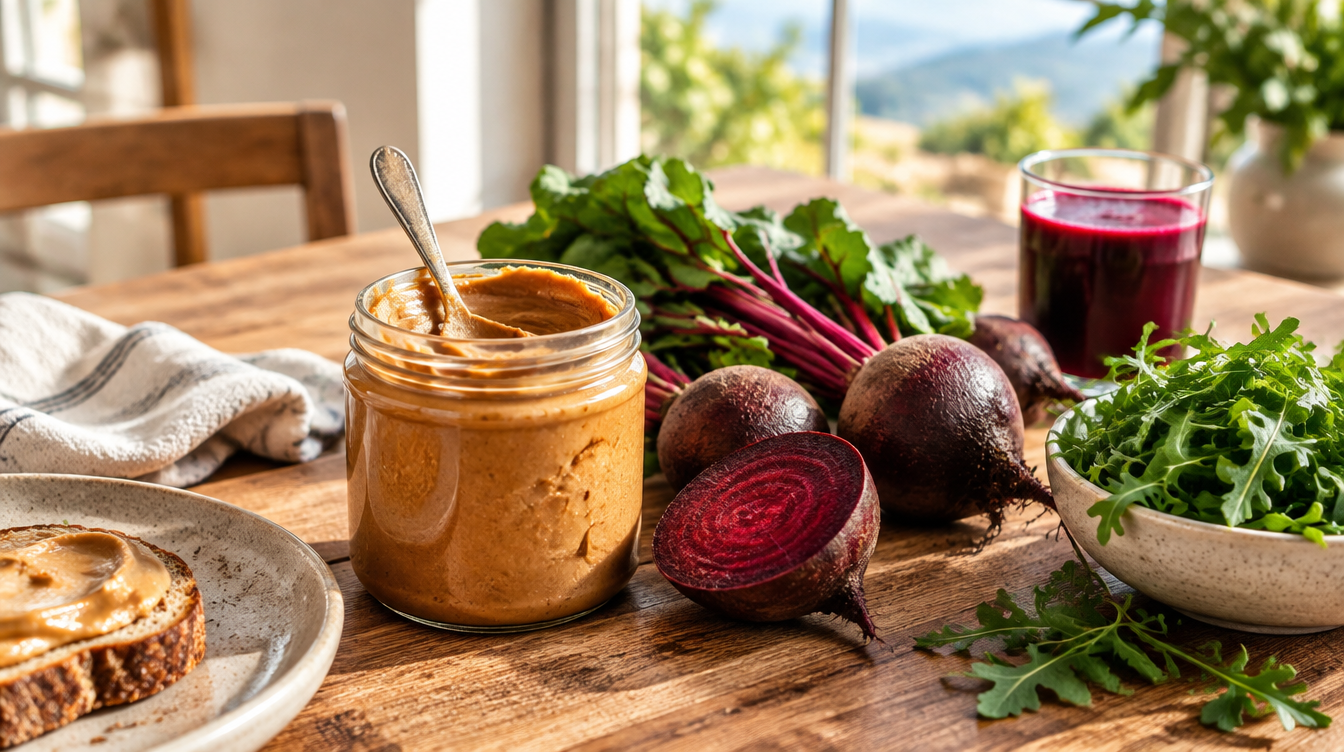
A new study made headlines for peanut butter. But the real story is about a kind of muscle most of us never think to train, and a humble root vegetable that may have beaten peanut butter to the punch.
This spring, the internet got very excited about peanut butter. A study out of Australia found that older adults who ate about three tablespoons a day for six months got faster at standing up from a chair.
Naturally, I was thrilled. A health study about something that actually tastes good? Finally. No green sludge. No counting macros. No pretending cauliflower is a perfectly acceptable substitute for mashed potatoes.
Then I read the fine print. The study was paid for by the peanut industry. The peanut butter was donated by Smucker’s. And the people in it were 66 to 89 years old and already at risk of falling. I’m 52. I’m not there yet, thank you very much.
But the more I dug, the more I realized the peanut butter wasn’t really the story. The story was what the peanut butter seemed to improve. Not muscle size. Not strength. Something called muscle power, which is how fast your muscles can fire.
And here’s the plot twist. An independent study funded by the National Institutes of Health found that a single glass of beet juice boosted that same kind of muscle power in older adults. Not in six months. In two hours.
So let’s talk about the muscle you lose first, why it matters long before 65, and why your next “power food” might turn your salad, and possibly your pee, a little pink.
First, What Did the Peanut Butter Study Actually Find?
The study came out of Deakin University in Melbourne and was published in February 2026 in the Journal of Cachexia, Sarcopenia and Muscle. (Say that three times fast.)
The 120 participants weren’t gym rats. They were adults 66 to 89, still living on their own, who had been flagged as being at risk of falling. Their average age was about 76. Half ate 43 grams of peanut butter a day, roughly three tablespoons. The other half just kept eating normally.
Six months later, everyone came back for testing: walking speed, balance, grip strength, leg strength and getting up and down from a chair.
Most of the results were a wash. The peanut butter group didn’t walk faster. They didn’t grip harder. Their leg strength didn’t improve. They didn’t gain muscle.
But on one test, they pulled ahead. Sitting in a chair with arms crossed over their chest, they stood up and sat down five times 1.23 seconds faster than the other group. From that test, researchers also calculated a boost in lower body muscle power.
Two more details I loved. Even with an extra 250 calories of peanut butter every day, the group didn’t gain significantly more weight than the people who skipped it. Six months of extra peanut butter without a noticeable difference on the scale? That’s the kind of research I enjoy reading.
And people actually stuck with it, eating about 86 percent of their assigned peanut butter. Most of us can’t stick with a new habit for six weeks.
So no, peanut butter didn’t make anyone stronger across the board. But it seemed to help with one very specific, very important thing: moving quickly.
Strength and Power Are Not the Same Thing
Most of us think about muscle in simple terms. Can I lift the suitcase? Carry the groceries? Open the pickle jar?
But scientists split muscle performance into two different things. Strength is how much force your muscles can produce. Power is how fast they can produce it.
Think about stepping off a curb that’s farther down than you expected. Or catching yourself when your foot slips on a wet kitchen floor. Being strong doesn’t help much if your muscles can’t react in time. You need speed.
Same with climbing stairs, getting up from a low couch, stepping into a boat or getting yourself up off the floor after playing with a grandkid. None of those are weightlifting contests. They’re everyday moments that need strength, coordination and speed all at once.
And here’s the part nobody tells you in your 40s and 50s: power tends to fade earlier and faster than strength. You can still carry a heavy grocery bag with no problem while quietly needing a little rock and a heave to get out of a low chair.
That doesn’t mean you’ve lost a lot of muscle. It means the muscle you have is getting a little slower to answer the phone.
The Fast Twitch Fibers That Quietly Leave First
Not all muscle fibers have the same job. Some are built for endurance, like walking, standing and puttering around all afternoon. Others are your sprinters. These fast twitch fibers kick in when you speed up, jump, catch your balance or pop up out of a chair.
As we age, changes in our nerves and muscles make that quick firing harder, and the fast twitch fibers are especially vulnerable.
The sneaky part is that losing power never sends a memo. You don’t wake up one day unable to climb the stairs. You just start taking them a little slower. You grab the armrest. You hesitate before stepping over the dog. You quietly stop doing anything that feels a little unpredictable.
And little by little, your world shrinks without you ever deciding to shrink it.
Which is exactly why this matters at 52, not 76. By the time you’re the age of the people in that study, you’re making withdrawals. Your 50s are when you get to make deposits.
Who Paid for the Peanut Butter?
Before we crown peanut butter, a quick word about the bill.
The study was funded by the Peanut Institute, an industry group, and the peanut butter was supplied by J.M. Smucker. That doesn’t make the research bad. The scientists publicly registered their trial before it started, which is exactly what good researchers do. But it’s worth knowing.
And honestly, it’s not unusual. Almost every food has a lobbyist. Almonds, avocados, eggs, blueberries, walnuts: there’s a board or council somewhere funding research on why their food is wonderful for you. Sometimes that research is excellent. It just means we should want independent scientists to repeat it.
There’s also a bigger question the study couldn’t answer. The comparison group didn’t get a different snack. So was there something special about peanut butter? Or did these older adults simply benefit from eating an extra 250 calories and 10 grams of protein every day? We don’t know. Yogurt, eggs or a handful of almonds might have done the same thing. Nobody tested them.
So peanut butter is an interesting contender. Not a muscle medicine.
Meet the Underdog: Beet Juice
Now for the vegetable that may have quietly beaten peanut butter to the punch.
Researchers at Indiana University and Washington University, funded by the National Institutes of Health, gave healthy older adults (average age 71) a single dose of beetroot juice. They used the gold standard setup: double blind, with a placebo version of the same juice, so nobody knew who got the real thing.
Two hours later, the results were in. Their maximal leg speed jumped almost 11 percent. Their leg power rose about 4.4 percent.
One drink. Two hours. Now, the scientists weren’t measuring things exactly the same way as the peanut butter researchers, so we can’t call it a fair fight. But still. Two hours!
The secret is nitrate, a compound found naturally in beets. Your body turns it into nitric oxide, a molecule that helps blood vessels relax and appears to help muscles contract faster and more efficiently. (Fun fact: the discovery of how nitric oxide works in the body won a Nobel Prize in 1998. Beets were apparently in on it the whole time.)
But here’s my favorite twist. When the same team tested different doses, the lower dose boosted muscle speed and power. The higher dose didn’t. More beet juice was not better.
In a wellness world obsessed with doubling everything, I find that deeply satisfying. Sometimes your body just wants a reasonable amount of a good thing.
Now, let’s be fair. These were tiny studies, with about a dozen people in the first one and even fewer in the follow-up. And nobody proved that drinking beet juice every morning will keep you climbing stairs at 90. But it’s an interesting little piece of the puzzle. And frankly, I’ll take any excuse to put more beets on my plate.
The Plot Twists Nobody Mentions
Here’s where beets get even more interesting.
Your mouthwash might be sabotaging you. Nitrate doesn’t work on its own. Friendly bacteria living on your tongue convert it into the form your body can use. Studies have found that strong antibacterial mouthwash can wipe out those bacteria and blunt the effect. So you might be drinking beet juice with one hand and canceling it out with the other.
Your salad is a secret power food. Beets aren’t the only nitrate superstars. Arugula is one of the richest sources around, along with spinach, celery and other leafy greens. That peppery arugula salad might be doing more than you thought.
And yes, beets can turn your pee pink. It’s called beeturia, it’s completely harmless, and it has sent more than a few people rushing to Google in a panic. Consider yourself warned.
One practical note: because nitrate can lower blood pressure, check with your doctor before going all in on beet juice if you take blood pressure medication. And beets are high in oxalates, so if you’re prone to kidney stones, that’s worth a conversation too.
So What Actually Works at 52?
Here’s the honest answer. At 52, if you’re already eating well, an extra 250 calories of peanut butter a day probably isn’t your secret weapon. What is backed by solid research is training for speed.
Traditional strength training usually means moving weights slowly and under control. I love my Pilates for exactly that reason: it’s controlled, precise and strong. But it’s not exactly built for speed.
Power training adds the missing ingredient: how fast you move. Instead of standing up slowly from a chair, you stand up with deliberate speed, then lower yourself back down slowly and with control. No launching. No bouncing. Nothing that ends with you in an urgent care waiting room. Just teaching your muscles to fire a little faster.
A 2022 review of 15 studies with 583 older adults found that power training generally improved muscle power and certain everyday performance tests more than regular strength training. And the American College of Sports Medicine’s 2026 guidelines now specifically call out power training, using moderate weights and faster movements.
The other piece is protein. Many experts suggest older adults aim for about 1.0 to 1.2 grams of protein per kilogram of body weight a day, which is more than the standard recommendation. For a 150-pound person, that’s roughly 70 to 80 grams a day, ideally spread across meals instead of crammed into dinner.
If you have balance problems, joint issues, osteoporosis or other health concerns, work with a trainer or physical therapist to build up safely. But the big idea is wonderfully hopeful: power responds to training at any age, and 52 is a fantastic time to start.
And Yes, You Can Cook With It
So can you skip the spoonful and put your peanut butter into a Thai peanut sauce, satay or a big bowl of peanut noodles instead? Absolutely. The protein and healthy fats don’t vanish when you cook.
Just two things to keep in mind. The study tested plain, natural peanut butter, not a sauce with added sugar. And if the benefit came from simply eating more, swapping peanut butter into a dish you’d eat anyway isn’t quite the same as adding it.
My advice? Cook with peanut butter because it’s delicious, not because it’s a muscle plan. Then toss some arugula on the side. Maybe roast a few beets. Your muscles may thank you. Your taste buds definitely will.
The Chair Test You Can Try Tonight
We’re very good at measuring the wrong things. We know our weight, our step count and maybe our body fat percentage down to the decimal. But when did you last pay attention to how easily you get out of a chair?
The five times sit to stand test from the peanut butter study is one of the simplest tools doctors and physical therapists use to check physical function. Here’s how it works: sit in a sturdy chair without arms, cross your arms over your chest, and stand up fully and sit back down five times as fast as you safely can. Time it. If you have trouble with balance or getting up from a chair, have a physical therapist guide you through it instead.
In older adults, taking longer than about 12 seconds is sometimes used as a sign of higher fall risk. But there’s no magic number you need to beat at 52. The point is to see where you are now, while getting out of a chair is still something you do without thinking about it. Because I’d much rather notice a change at 55 than be surprised by it at 75.
To be clear, it’s not a diagnosis. Chair height, pain, balance and plenty of other things affect your time. But it’s a great reminder that the most meaningful signs of healthy aging often have nothing to do with how we look. They’re about what we can still do.
Can you get up off the floor without a grunt and a game plan? Climb stairs without hauling yourself up by the railing? Slide out of a low restaurant booth without plotting your escape route?
That last one is especially important after a big dinner.
THE SEPTEMBER TAKE
I came for the peanut butter and stayed for the beets.
The peanut butter study is a fun headline, but its most interesting lesson isn’t about peanuts at all. It’s that people got better at a real, everyday movement without gaining muscle or traditional strength. They got better at moving fast. And that’s the kind of muscle we lose first and think about least.
At 52, I’m not trying to fix a problem. I’m trying to make sure I never have one. That means training for speed, eating enough protein, maybe adding some arugula and beets, and enjoying my peanut sauce purely because it’s delicious.
I want to climb stairs, carry my groceries, get up off the floor and slip out of a restaurant booth without turning it into a group project. For a very long time.
And if a little peanut butter comes along for the ride? Even better. Just don’t ask me to measure it every morning. Some pleasures deserve to stay pleasures.
Do This Week
1. Take the chair test.
Five times sit to stand, arms crossed, as fast as you safely can. Write down your time. Check it again in six months. If you have balance problems or difficulty standing, ask a physical therapist to help you assess it safely.
2. Add speed to your workouts.
Try standing up from a chair or doing step ups with a quick, controlled push up and a slow lower. If you have balance or joint concerns, ask a trainer or physical therapist to help.
3. Keep strength training in the mix.
The 2026 American College of Sports Medicine guidelines recommend working all major muscle groups at least twice a week. Consistency beats complexity.
4. Check your protein.
For generally healthy older adults, many experts recommend about 1.0 to 1.2 grams per kilogram of body weight a day, spread across meals rather than saved up for dinner. Your individual needs may differ.
5. Eat your nitrates.
Arugula, spinach, celery and beets are all great sources. Try a beet and arugula salad this week.
6. Rethink the mouthwash.
If you use a strong antibacterial mouthwash every day, it may be wiping out the bacteria that help your body use nitrate. Ask your dentist whether a gentler option makes sense for you.
7. Make independence the goal.
Not a number on the scale. Not a jeans size. The goal is to keep doing the things you love, comfortably and confidently, for as long as possible.
September Wellness provides educational information about nutrition, muscle aging and physical function. Research findings do not establish peanut butter or beetroot juice as a treatment for age-related muscle loss or a way to prevent falls. Dietary needs and safe exercise recommendations vary according to individual health, mobility and medical conditions. Consult a qualified healthcare professional before making significant changes to your diet or exercise routine, particularly if you have a history of falls, balance difficulties, kidney stones, low blood pressure or chronic medical conditions.
Sources & Further Reading
1. Feyesa, I., Hettiarachchi, J., Daly, R. M., et al. Effects of Peanut Butter Supplementation on Older Adults’ Physical Function: A 6-Month Randomised Controlled Trial. Journal of Cachexia, Sarcopenia and Muscle, 2026. The headline study involving 120 older adults. Daily peanut butter improved chair-rise performance and estimated leg muscle power, but not walking speed, measured strength or muscle mass.
2. Deakin University. Peanut Butter Helps Build Muscle Power in Older Adults, Study Shows. Deakin University, March 2026. The university’s explanation of the study, including its design, findings and funding.
3. Coggan, A. R., Hoffman, R. L., Gray, D. A., et al. A Single Dose of Dietary Nitrate Increases Maximal Knee Extensor Angular Velocity and Power in Healthy Older Men and Women. The Journals of Gerontology: Series A, 2020. The small, NIH-funded beetroot-juice study reporting improvements in leg movement speed and muscle power approximately two hours after drinking nitrate-rich beet juice.
4. Gallardo, E. J., Gray, D. A., Hoffman, R. L., et al. Dose-Response Effect of Dietary Nitrate on Muscle Contractility and Blood Pressure in Older Subjects. The Journals of Gerontology: Series A, 2021. A follow-up study finding that a lower nitrate dose improved certain measures of muscle speed and power, while a higher dose did not produce the same results.
5. Ponsen, M. M., et al. Effectiveness of Power Training Compared to Strength Training in Older Adults: A Systematic Review and Meta-Analysis. European Review of Aging and Physical Activity, 2022. A review of 15 trials examining whether exercises emphasizing movement speed offer advantages over conventional strength training for older adults.
6. American College of Sports Medicine. ACSM Unveils Landmark 2026 Resistance Training Guidelines. ACSM, March 2026. Updated exercise recommendations covering muscle strength, growth and power, with an emphasis on consistent, individualized resistance training.
7. Bauer, J., Biolo, G., Cederholm, T., et al. Evidence-Based Recommendations for Optimal Dietary Protein Intake in Older People: A Position Paper From the PROT-AGE Study Group. Journal of the American Medical Directors Association, 2013. Expert recommendations suggesting that generally healthy older adults may benefit from approximately 1.0–1.2 grams of dietary protein per kilogram of body weight daily.
8. Sherrington, C., Fairhall, N. J., Wallbank, G. K., et al. Exercise for Preventing Falls in Older People Living in the Community. Cochrane Database of Systematic Reviews, 2019. A large review showing that appropriately designed exercise programs, particularly those emphasizing balance and functional movement, can reduce falls among community-dwelling older adults.
9. Bondonno, C. P., et al. Antibacterial Mouthwash Blunts Oral Nitrate Reduction and Increases Blood Pressure in Treated Hypertensive Men and Women. Hypertension, 2015. Research exploring how antibacterial mouthwash can interfere with oral bacteria involved in converting dietary nitrate into nitrite, an important step in nitric-oxide production.