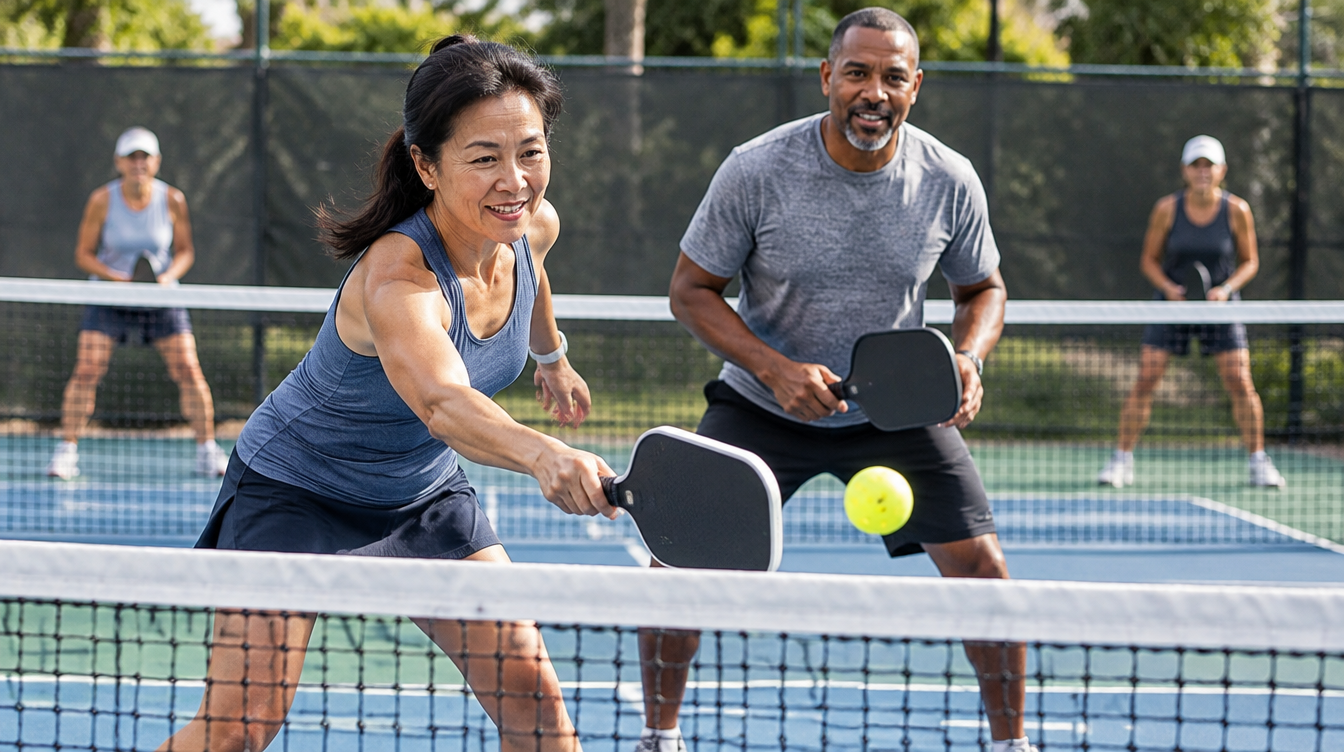
My friends have leagues, standing pickleball dates and charity tournaments. I have a tennis background, lingering confusion about “the kitchen,” and some questions about why everyone is so obsessed.
I’ve tried pickleball. More than once, actually. And I still don’t get it.
Maybe the problem is that I played tennis for years. I love the physicality of tennis: the big aggressive strokes, the deeply satisfying feeling of really hitting a ball, the movement and the rhythm of it all.
Pickleball, I’ve discovered, has an entirely different personality. There’s the kitchen, which is not a kitchen. There are dinks, which are not what you think they are. And there are all these little strategic decisions about exactly where to place the ball, while every tennis instinct in my body is screaming at me to just hit it.
I still remember my coach yelling “Kitchen! Kitchen!” while I was still trying to figure out what the word even meant, never mind appreciate its finer points. I gave it a few chances. It didn’t take.
Apparently, I’m in a very small minority. Because just about everyone I know has discovered a deep and abiding love for pickleball. Friends have standing game days, leagues and tournaments. Charity fundraisers that used to be golf outings or tennis socials are now hosting pickleball competitions. And it’s not just the people I would have predicted. Friends in their 40s, 50s, 60s and beyond, with wildly different personalities and athletic histories, are rearranging their entire schedules around a little plastic ball with holes in it. Some play several times a week.
Then there’s the other side of it. I’ve heard about a surprising number of serious injuries among friends and acquaintances, especially men dealing with torn Achilles tendons and knee problems, some of them ending in surgery.
Which raises two pretty obvious questions. How did this little paddle game become one of America’s biggest sporting obsessions? And why does something that looks so gentle sometimes end with an appointment at the orthopedic surgeon?
24 Million People Can’t All Be Wrong. Can They?
Apparently the rest of America has decided pickleball is a terrific idea. According to the Sports & Fitness Industry Association’s 2026 report, 24.3 million Americans played pickleball in 2025. In 2020, it was about 4.2 million. That’s nearly six times as many players in just five years.
And these aren’t just millions of people who tried it once, bought a paddle and quietly let it gather dust. The number of what the industry calls “core” players, people who play at least eight times a year, jumped from 1.4 million in 2020 to 7.5 million in 2025. Eight times a year isn’t exactly an all consuming addiction, but it does mean a whole lot of people keep coming back.
And while pickleball got its early reputation as a retirement community pastime, the picture has changed. The highest participation rates are now among people ages 13 to 24, and women make up nearly 43 percent of players. So this isn’t just a shuffleboard alternative that got out of hand. It’s become a genuinely intergenerational sport, pulling in teenagers, working adults, empty nesters and retirees.
Here’s a fun bit of history: pickleball was invented in 1965 on Bainbridge Island, near Seattle, by three dads trying to entertain their bored kids with a badminton court, ping pong paddles and a plastic ball. One of them, Joel Pritchard, later became a U.S. congressman. As for the name, the family story goes that it came from a “pickle boat,” the rowing term for a crew thrown together from leftover rowers, since the game was cobbled together from leftover equipment. Another version credits the Pritchards’ dog, Pickles, though the family insists the dog was named after the game, not the other way around. Today it’s the official state sport of Washington.
So how does a game invented to cure summer boredom end up appealing to people who might otherwise have almost nothing in common?
Maybe My Problem Is That I’m Thinking Like a Tennis Player
Here’s what I didn’t fully appreciate the first time I played: pickleball isn’t trying to be miniature tennis. The court is smaller, the paddle is different, the ball behaves differently, and the rules reward an entirely different way of controlling a point.
Take the infamous kitchen. For the uninitiated, it’s the seven foot zone on either side of the net, officially called the non-volley zone. (Some say the nickname was borrowed from shuffleboard, which has its own “kitchen” penalty area.) You can step into the kitchen and hit a ball after it bounces, but you can’t volley, meaning hit the ball out of the air, while standing in it. You also can’t let your momentum from a volley carry you in there. Hence my coach’s repeated announcements.
Then there’s the dink: a deliberately soft shot, usually played near the kitchen line, designed to drop into your opponent’s kitchen. The goal isn’t to overpower anyone. It’s to make them uncomfortable, force a weak return and set up a chance to attack.
I understand all of this intellectually now. Emotionally, I’d still rather hit a tennis ball with some real conviction.
But here’s the thing I had to admit: the subtlety that drove me crazy is exactly what other people find addictive. Pickleball rewards patience, anticipation, placement and the ability to read what your opponent is about to do. A good player isn’t just swinging harder. They’re setting up the next shot, and maybe the one after that. It’s a physical game with a chess player’s personality. And once you start seeing the strategy, I can see how winning a point would feel less like luck and more like solving a little puzzle. A puzzle that comes with a paddle, some exercise and your friends.
The Game That Gets Harder the Better You Get
I suspect this is one of pickleball’s cleverest tricks. You can learn enough to start playing pretty quickly. The court is compact, the equipment is cheap and approachable, and a casual doubles game doesn’t demand the endurance or technical skill that competitive tennis does. That makes the first step much less intimidating.
But the learning curve doesn’t stop there. As players get better, rallies speed up, positioning starts to matter enormously, and those soft little dinks start setting up lightning fast exchanges at the net. You learn when to attack, when to slow things down, when to move forward and when you’re about to get caught out of position. Suddenly the game that looked like four friends gently patting a plastic ball around turns out to be something much more intense.
Easy enough to start. Complicated enough to keep getting better at. Most hobbies struggle with one side of that equation. They’re either hard enough to scare off beginners or simple enough that people eventually get bored. Pickleball has found the sweet spot.
And unlike a workout where your progress shows up as a number on a watch, your improvement is right there in front of you every time you play. You win a rally you’d have lost six months ago. You finally master that annoying little shot. You get invited to play with a stronger group. And before you know it, your Tuesday afternoons are no longer available, because Tuesday is now pickleball day.
The Social Calendar Has Officially Been Taken Over
This might be the part I find most fascinating. Pickleball isn’t just something people do for exercise anymore. It’s something they organize their whole lives around.
My friends have standing games, leagues and tournaments. Couples play together. Friends bring friends. Mixed groups of men and women, of all ages and athletic histories, gather around courts that have become regular meeting places. I’ve even watched charity fundraisers migrate to pickleball, which tells you something. When a sport becomes social enough that organizers can build an entire event around it, expecting people to play, watch, mingle and donate, it’s become more than a sport.
You don’t have to be the best player there to have a reason to show up. That’s a real advantage over some sports, where the gap between experienced and newer players makes playing together awkward. Pickleball’s doubles format, friendly atmosphere and habit of grouping games by skill level let people join in without every outing turning into an athletic exam.
And there’s something else going on here that deserves attention. As we get older, friendship takes more deliberate effort. The kids grow up. Work schedules shift. People move away. The easy, built-in chances to see the same friends every week quietly disappear. A standing pickleball date solves that surprisingly hard adult problem. Nobody has to spend three weeks trading texts to coordinate a lunch. You just show up Thursday morning with your paddle.
The research is starting to capture this. A 2025 systematic review found that playing pickleball was linked with better social connection and wellbeing, especially among older adults. Much of that research is observational, so it can’t prove pickleball itself makes people happier. But a game that combines movement, laughter, routine, a little competition and regular time with friends has some pretty obvious attractions.
Maybe people aren’t actually addicted to the sport. Maybe they’re addicted to how their lives feel when they play it.
Your Gym Workout May Not Have Prepared You for This
Now for the part that worries me. I’ve heard about enough Achilles injuries and bad knees among my pickleball playing friends to wonder whether people are underestimating what this game asks of their bodies. And many of the people getting hurt aren’t couch potatoes. They’re men who go to the gym, lift weights and think of themselves as fit.
Then they step onto a pickleball court, where an innocent little ball suddenly requires them to rush forward, plant a foot, stop on a dime, pivot sideways and lunge for a shot they absolutely refuse to let their opponent win. And sometimes something gives.
There’s a reason for that. Being strong in the gym is not the same as being conditioned for sudden changes of direction. Lifting weights builds valuable strength, but court sports also demand acceleration, deceleration, balance, quick reactions, resilient tendons and the ability to absorb force from unpredictable angles. Those can all be trained, but they don’t come automatically with a good gym routine.
And it’s especially easy to underestimate those demands when the sport looks so much gentler than tennis, basketball or running. You’re not covering a huge field. You’re not swinging anything heavy. You’re just chasing a little ball around a small court. Until you’re not just doing anything. You’re playing to win. And a small court doesn’t eliminate explosive movement. It just squeezes all of it into a smaller space.
The Injury Numbers Are More Serious Than You’d Expect
These injuries aren’t just dinner party gossip. They’re showing up in orthopedic offices and emergency rooms.
A 2026 study looked at pickleball related orthopedic injuries treated across a large urban health system from 2015 to 2024. Sixty percent involved the lower body, with the knee hit most often, followed by the ankle. Across all the patients, researchers documented 62 meniscus tears and 30 ruptured Achilles tendons. Those numbers sound eerily similar to what I’ve been hearing in my own circle of friends.
A 2024 study of 166 patients treated for pickleball and paddleball injuries to the legs and feet found that Achilles ruptures made up 12 percent of the cases, and most of them needed surgery.
Keep in mind these were injured patients, not a random sample of everyone who plays, so the percentages tell us what doctors are seeing, not your odds of tearing an Achilles next Saturday. But the pattern is real.
And it’s not just middle aged men. A 2025 national analysis estimated that pickleball injuries treated in emergency rooms jumped from about 1,300 in 2014 to more than 24,000 in 2023. Players ages 40 to 59 were more likely to come in with leg and foot injuries, while older players who got hurt had higher risks of falls and fractures. That’s a useful distinction: the 50 year old lunging for a ball and the 75 year old who loses their balance can get very different injuries playing the very same game.
To be fair, a rise in total injuries doesn’t prove the game itself is getting more dangerous. Far more people are playing now, and we still need better data on injuries per hour played and how pickleball compares with other recreational sports. The point isn’t that pickleball is a bad idea. It’s that its physical demands deserve a lot more respect than its friendly reputation suggests.
The Achilles Tendon Hasn’t Heard That This Is Supposed to Be Fun
Of all the pickleball injuries, the Achilles deserves special attention. It’s the thick tendon connecting your calf muscles to your heel, and it’s what propels you forward every time you walk, run or push off the ground. During a quick burst of speed or a sudden change of direction, it takes an enormous amount of force.
Regular exercise is important for keeping strong and capable, but not every tendon is ready for explosive movement just because its owner is generally active. An Achilles rupture often happens during a sudden push off, and people commonly describe it as feeling like someone kicked them hard in the back of the leg, then turning around to find no one there.
An orthopedic specialist at UTHealth Houston specifically called out pickleball’s quick sideways movements, sudden stops and explosive push offs in a 2026 piece on foot and ankle injuries. That doesn’t mean everyone who plays is one bad step away from a ruptured tendon. Most players never experience one. But the game makes demands that can catch people off guard, especially when enthusiasm and competitive instinct develop much faster than conditioning.
And that’s not unique to pickleball. It’s familiar to anyone who has decided, after years away from a sport, that they can still move exactly the way they did at 25. The brain remembers. The Achilles may have a different opinion.
Why the Risk Doesn’t Cancel Out the Benefits
It would be easy to turn all this into an argument against pickleball. I don’t think that’s fair. There are excellent reasons to encourage people to play recreational sports, especially in midlife. Movement, cardio, balance, coordination, social connection and the joy of learning a new skill are all genuinely valuable, and enjoying them together matters even more.
A 2025 review of research on pickleball and padel linked playing with better psychological wellbeing and stronger social connection. A separate 2025 study found that people who played pickleball more often reported higher wellbeing scores, with especially strong links in older adults. Interestingly, players who had recently been injured had lower wellbeing scores.
That last finding is worth remembering. There’s a cruel irony in finding something that brings you new friends, joy and motivation, only to have an injury sideline all three at once. Which is exactly why injury prevention isn’t about making the game less fun. It’s about protecting your ability to keep enjoying it.
Maybe We Should Stop Calling It a Gentle Sport
Pickleball certainly can be gentle. A relaxed doubles game among friends can be a lovely, low key way to move. But the same sport can also get fast, demanding and surprisingly aggressive. And that’s where the reputation and the reality sometimes drift apart. Just because something is easy for beginners doesn’t mean it stays easy on your body as your skills improve.
The answer isn’t necessarily more stretching before a match or another expensive pair of court shoes, although good footwear and a smart warmup absolutely help. It’s understanding that pickleball requires a specific kind of athleticism. If you plan to play often and competitively, your preparation should go beyond general gym fitness: practicing court movement, balance, sideways footwork, controlled stopping, lower body strength and proper recovery. If you’re coming back to sports after a long break, build up gradually. And if you have ongoing tendon or joint pain, take it seriously instead of treating it as the price of improving.
Because one of the funny things about pickleball is that it’s so entertaining people don’t notice how hard their bodies are working. Until afterward. Or until something hurts.
The Secret Might Be That Pickleball Doesn’t Feel Like Exercise
After digging into the numbers, the injuries and the social phenomenon, here’s where I’ve landed. I still don’t particularly want to play pickleball. I like tennis. I like Pilates. I know what I enjoy. And I remain unconvinced that “the kitchen” needs to be part of my recreational vocabulary.
But I understand the appeal far better than I did before. Pickleball gives adults something surprisingly hard to find: a regular reason to move, socialize, get better at something and have fun, without making the whole thing about health. Nobody needs to lecture you about cardiovascular fitness when you’re already excited to meet your friends at the courts. You don’t need a reminder to stay active when you’ve spent all week looking forward to Thursday’s game.
Maybe that’s why it’s become so irresistible to people who would never call themselves athletic. It doesn’t start with an instruction to exercise. It starts with an invitation to play. The exercise is almost an afterthought, until the competition gets serious, and then it’s anything but.
That combination may be pickleball’s greatest strength and its most overlooked weakness. It’s easy to fall in love with a game before you fully appreciate what your body needs to play it well.
And if watching my friends’ growing devotion has taught me anything, it’s that people will make an extraordinary amount of room in their lives for something they genuinely love. Even if it involves a kitchen you can’t cook in.
THE SEPTEMBER TAKE
I still don’t love pickleball. But 24 million Americans seem perfectly happy without my endorsement.
What I do love is that it’s bringing together people of all ages and fitness levels, giving them a reason to move, compete and see each other every week. The injuries deserve real attention, especially when people mistake an easy to learn game for an easy on the body sport.
But maybe pickleball’s real achievement is making staying active feel less like a responsibility and more like having a life.
I’ll stick with tennis and Pilates. Everyone else can have the kitchen.
Do This Week
1. If you play, be honest about how hard you actually play.
A friendly beginner game and a fast competitive match put very different demands on your body. Prepare for the version you’re playing now, not the one you started with.
2. Don’t confuse gym fitness with court readiness.
Strength matters, but so do balance, quick changes of direction, stopping safely and recovering from awkward movements. Consider working on these gradually with a qualified coach.
3. Warm up for the movements, not just the clock.
Start gently, then work in the sideways steps, controlled lunges and direction changes the game demands. Don’t go straight from your car seat into your most competitive rally.
4. Listen to your Achilles and your knees.
Ongoing heel or tendon pain, knee swelling or a knee that feels unstable shouldn’t be ignored. A sudden pop, sharp pain or not being able to push off means get checked out right away.
5. Give yourself time to recover.
When a new sport becomes a social obsession, it’s tempting to play every single day you can. Build up how often and how hard you play gradually, instead of letting your social calendar decide your recovery.
6. Enjoy the community, whether you play or not.
A league, a walking group, a tennis club, a dance class or a standing Pilates session can give you the same wonderful combination of movement and familiar faces.
7. Don’t worry if you don’t love the latest trend.
There’s no rule that says you have to love pickleball just because everyone else does. The best activity for you is the one that fits your body, your interests and your life well enough that you keep coming back.
September Wellness provides educational information about recreational sports, fitness, injury risks and healthy aging. This article is not individualized medical advice, diagnosis or a personalized exercise program. Pickleball involves risks of falls, tendon and joint injuries, and overexertion. Consult an appropriate healthcare professional if you have an injury, medical condition, concerning symptoms or questions about safely beginning or increasing activity. Sudden severe pain, a suspected tendon rupture or inability to bear weight requires prompt evaluation.
Sources & Further Reading
1. Sports & Fitness Industry Association (SFIA). SFIA Releases 2026 Pickleball Single Sport Report. SFIA, June 2026.
Documents the growth of pickleball in the United States, including 24.3 million participants in 2025, increased regular participation and the sport’s expanding appeal among younger adults.
2. USA Pickleball. Official Pickleball Rules Summary. USA Pickleball.
Explains the rules of the game, including the non-volley zone, commonly called the kitchen, and how pickleball differs from tennis.
3. Siow, M. Y., Zafar-Khan, A., and Limpisvasti, O. Pickleball-related Orthopaedic Injury Presentations to a Large Urban Healthcare System From 2015 to 2024. Journal of the American Academy of Orthopaedic Surgeons Global Research & Reviews, 2026.
Examines 545 pickleball-related injuries, including knee problems, meniscus tears, Achilles tendon ruptures and the types of medical treatment required. <Cite ref=”turn251996search4″/>
4. Opara, O. A., Brush, P. L., Pohl, N., et al. Pickleball- and Paddleball-Related Injuries in the Lower Extremity: Description, Treatment Options, and Return to Play. Cureus, 2024.
Studies 166 patients with lower-extremity injuries, including Achilles ruptures, and examines treatment and return-to-play outcomes. <Cite ref=”turn684186view4″/>
5. McMillan, P., Lake, L. P., Burkhart, A., et al. The Epidemiology of Pickleball Injuries Presenting to US Emergency Departments. Sports Health, published online 2025; July–August 2026 issue.
Analyzes national emergency-department data from 2014 through 2023, documenting rising injury numbers and different injury patterns across age groups. <Cite ref=”turn251996search2″/>
6. Lauxtermann, L., and Stubbs, B. Padel, Pickleball and Wellbeing: A Systematic Review. Frontiers in Psychology, 2025.
Reviews research linking recreational racquet sports with psychological wellbeing, social connection, happiness and life satisfaction, particularly among older adults. <Cite ref=”turn251996search3″/>
7. Owoeye, O. B. A., Grese, J., Stenersen, M., et al. The More You Play, the Better You Feel: A Dose–Response Analysis of Pickleball and Mental Wellbeing in U.S. Adults. Frontiers in Psychology, 2025.
Examines relationships between how frequently adults play pickleball, their reported mental wellbeing and the effects associated with recent injuries. <Cite ref=”turn251996search9″/>
8. Beltran, A. Pickleball Foot and Ankle Injuries: Prevention Tips. UTHealth Houston, March 2026.
Discusses the demands pickleball places on the feet and ankles, including sudden direction changes, explosive push-offs and practical injury-prevention considerations.
9. USA Pickleball. About and History of USA Pickleball. USA Pickleball.
Traces the sport’s beginnings in 1965 on Bainbridge Island, Washington, and explains how Joel Pritchard, Bill Bell and Barney McCallum developed the game.
10. Washington State Legislature. Washington State Sport: Pickleball. Washington State Legislature, 2022.
Confirms pickleball’s Washington origins and its designation as the state’s official sport in 2022.