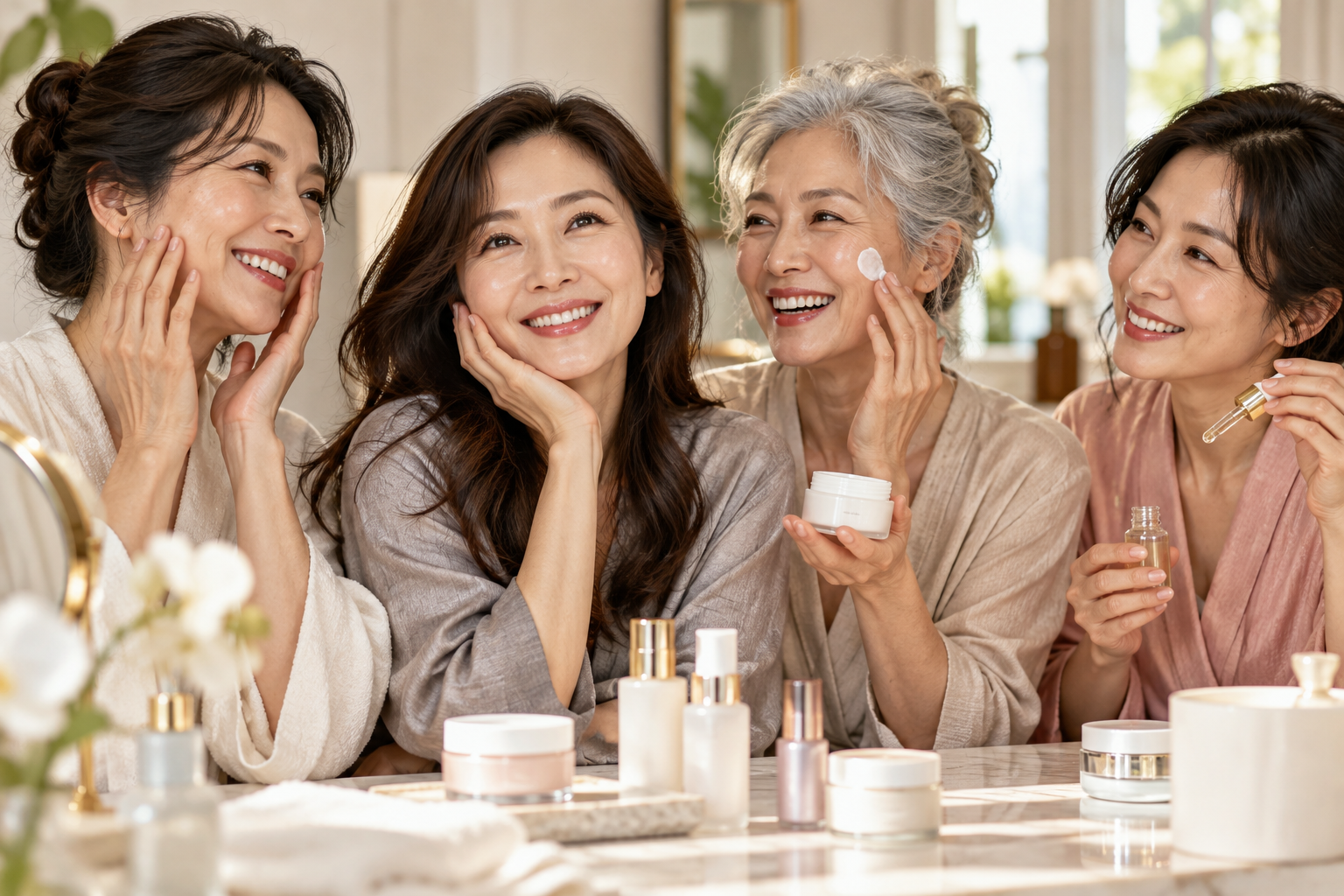
What copper peptides, Korean barrier creams, and smarter sunscreen formulations reveal about caring for skin after 40.
Here’s something nobody mentions when you buy your first Serious Grown-Up Serum: your skin isn’t just losing collagen. The whole system that maintains and repairs that collagen is changing.
Some of those changes have surprisingly little to do with how many birthday candles are on the cake.
Hormones, sun exposure, inflammation, and the way skin cells communicate all affect how well your skin keeps itself in good shape. That’s why the moisturizer you’ve been loyal to for 15 years can suddenly feel like it’s phoning it in.
And here’s where things get interesting.
While researchers are investigating how peptides influence tissue repair and collagen production, Korean skincare laboratories have been approaching another part of the same problem from a remarkably practical angle: how do we keep the skin barrier healthy, comfortable, and functioning well in the first place?
It’s a fascinating intersection of regenerative science and formulation technology. One that takes us from copper peptides and collagen research to Korean barrier creams and sunscreens that feel more like elegant moisturizers than traditional sunblock.
The good news? We understand considerably more about these processes than we did even a decade ago.
And some of the most interesting developments aren’t coming from another $400 cream with a celebrity’s name on it. They’re coming from research into cellular repair, peptides, and some very clever formulation work happening in laboratories from Seoul to Paris.
Let’s get into it.
Your skin has a maintenance department (and it’s understaffed)
Think of your skin as a house that’s always under renovation.
Fibroblasts are the contractors. They produce collagen and other structural materials that help keep everything firm. Your skin barrier is the front door, keeping moisture in and irritants out. And a network of signaling molecules acts as the project manager, coordinating repairs.
In your 20s, this crew generally shows up on time, works efficiently, and cleans up after itself.
With age, the crew gets a little less reliable. Fibroblast activity changes. Collagen becomes more fragmented, more like a frayed rope than a fresh one. And skin can take longer to recover from everyday stress.
It’s not quite contractors who leave for lunch and come back Thursday, but it’s heading in that direction.
Here’s a detail most people don’t know: fragmented collagen can actually make the problem worse.
Researchers have found that when fibroblasts are surrounded by damaged, fragmented collagen, they lose some of the physical support they need to function properly. Their collagen production can decline as a result.
In other words, the deterioration of collagen can interfere with the very cells responsible for replacing it.
Damage can contribute to further damage. It’s one reason skin aging can become a self-reinforcing process.
Sun exposure accelerates much of this. But even the most devoted sunscreen loyalists experience intrinsic aging and hormonal changes.
That’s why mature skin can become thinner, drier, more reactive, or simply slower to bounce back after a bad night or a long flight.
And it raises an interesting question: what if better skincare isn’t just about replacing what we’ve lost, but also about supporting the systems responsible for maintaining what we have?
That’s where the conversation gets much more interesting.
The menopause connection goes well beyond wrinkles
Estrogen isn’t just a reproductive hormone. It’s practically on the board of directors for your skin, influencing collagen, hydration, thickness, and wound healing.
So when estrogen levels decline around menopause, skin can lose some of its structural support and ability to retain moisture.
How much? Some frequently cited research estimates that skin collagen may decline by as much as 30% during the first five years after menopause, although the amount varies from person to person.
Five years. That’s not exactly a leisurely pace.
And collagen isn’t the only thing changing. Skin may produce less oil, become more sensitive, and take longer to recover from irritation. Even products that once felt wonderful can suddenly seem too harsh or not moisturizing enough.
This is why a woman who’s used the same skincare routine for a decade can suddenly feel like her skin has been swapped with someone else’s.
It isn’t necessarily asking for a pricier moisturizer. It may be asking for a different strategy: more barrier support, gentler or less frequent active ingredients, and a second look at products it tolerated perfectly well ten years ago.
And men, you’re in this too.
Male skin is generally thicker, and hormonal changes tend to follow a different, more gradual timeline. But collagen remodeling, accumulated sun damage, and changes in moisture retention still happen.
Somewhere around 50, plenty of men discover that soap and whatever happens to be in the shower may no longer qualify as a complete skincare routine.
The larger point is that mature skin deserves more thoughtful care than simply being told to exfoliate harder.
And understanding these changes helps explain why researchers are so interested in ingredients that may influence collagen production, tissue remodeling, and skin repair.
Which brings us to one of the more fascinating peptides in skincare: GHK-Cu.
Meet GHK-Cu, the copper peptide with a backstory
If you’ve spent any time exploring the regenerative skincare corner of the internet, you’ve probably encountered GHK-Cu.
And unlike some ingredients that seem to appear overnight with a celebrity endorsement, this one has a surprisingly long scientific history.
GHK is a tiny, naturally occurring peptide made up of just three amino acids. It’s found in human plasma, saliva, and urine. (Yes, really. Science is glamorous.)
When GHK binds to copper, it forms GHK-Cu, a complex scientists have been studying since the 1970s.
Why copper?
Because copper is involved in some remarkably important biological processes, including connective tissue formation, antioxidant defenses, and tissue repair. It’s one of those minerals that quietly does a tremendous amount of work without getting much attention.
And GHK-Cu appears to do considerably more than simply carry copper around.
Researchers have investigated its influence on collagen production, extracellular matrix remodeling (the scaffolding that supports our cells), inflammation, and wound healing.
Here’s where it gets particularly interesting.
Gene-expression studies suggest that GHK can influence the activity of a surprisingly large number of genes, including some associated with tissue repair and remodeling, at least in laboratory research settings.
That’s fascinating because it suggests researchers may be looking at something more complex than an ingredient that simply stimulates collagen production.
They’re investigating how this peptide interacts with the biological signaling involved in maintaining and repairing tissue.
And that brings us back to our skin’s maintenance department.
What if, instead of focusing exclusively on replacing lost collagen, we could better understand the signals that tell our cells when and how to repair the surrounding tissue?
That’s part of what makes GHK-Cu such an intriguing area of research.
So, does GHK-Cu actually work?
And there’s another fascinating direction to this research: injectable GHK-Cu.
While topical formulations focus primarily on delivering the peptide through the skin, injectable GHK-Cu is being explored through a different lens, one involving systemic exposure and the broader biological pathways associated with tissue maintenance and repair.
It’s an intriguing distinction. Much of the research interest surrounding GHK-Cu extends beyond cosmetic appearance to collagen-related signaling, inflammation, extracellular matrix remodeling, and wound healing.
That broader biological activity is precisely why injectable GHK-Cu has attracted attention within the peptide research community.
The important scientific distinction is that promising laboratory findings and topical studies don’t yet establish the clinical benefits, optimal dosing, or long-term safety of injectable GHK-Cu in humans. Those questions deserve more research.
And that’s what makes this field worth following: we’re still learning how a naturally occurring peptide involved in tissue biology might be understood and potentially applied in different ways.
How to shop for copper peptides without getting played
Here’s where reading the ingredient list beats reading the marketing every time.
If you’re shopping for GHK-Cu skincare, the name to look for is Copper Tripeptide-1.
You’ll find it in products across several price points, including The Ordinary Multi-Peptide + Copper Peptides 1% and NIOD Copper Amino Isolate Serum 3 1:1, both from the DECIEM family of skincare brands.
The Ordinary takes a relatively straightforward approach, combining copper peptides with other peptide ingredients in a water-based serum.
NIOD positions its copper-peptide serum as a more specialized formulation, with a different ingredient system and a considerably higher price tag.
Does that automatically make NIOD better?
Not necessarily.
Here’s the catch: seeing Copper Tripeptide-1 on an ingredient list doesn’t tell you everything about how much is present, how stable the finished formulation is, or how effectively the peptide reaches its intended target in the skin.
And even a prominently advertised concentration doesn’t necessarily tell you how the product will perform compared with another formula.
A few rules worth remembering:
Gorgeous packaging is not a mechanism of action. An expensive serum with an impressive ingredient list isn’t automatically better than a well-formulated product costing a third as much.
More peptides doesn’t necessarily mean better results. A serum advertising eleven different peptides isn’t automatically more effective than one built around a smaller number of carefully selected ingredients.
The whole formula matters. Concentration, stability, compatibility with other ingredients, and delivery into the skin all influence whether a promising ingredient becomes a useful finished product.
And one more thing: copper peptides aren’t necessarily an overnight-results ingredient.
Much of the interest surrounding GHK-Cu involves biological processes that unfold over time, including collagen-related activity and tissue remodeling. That makes dramatic before-and-after promises worth approaching with some skepticism.
The exciting part isn’t finding the bottle with the biggest claims.
It’s recognizing that skincare formulation is becoming increasingly sophisticated, and that ingredients once discussed mainly in research laboratories are finding their way into everyday cosmetic products.
Which raises another interesting question: how do these newer ingredients compare with the treatments dermatologists have been recommending for decades?
Retinoids are still the valedictorian
With all the excitement surrounding peptides, it’s easy to overlook one of the most thoroughly researched ingredients in dermatology.
Retinoids.
Prescription tretinoin has decades of clinical research showing that it can improve visible signs of sun-damaged skin, including fine lines, rough texture, and uneven pigmentation.
Retinol and retinal (retinaldehyde) are its cosmetic cousins, available in countless over-the-counter products. How well they perform depends on their concentration, stability, and the way they’re formulated.
A thoughtfully formulated retinol can be terrific. A poorly formulated one may be little more than expensive hope.
So where do copper peptides fit?
Not necessarily as competitors.
Retinoids are known for influencing skin-cell turnover and collagen-related processes. Copper peptides are attracting interest for their potential involvement in tissue maintenance, repair signaling, and extracellular matrix remodeling.
Both are fascinating, but the depth of human clinical evidence behind them isn’t in the same league. At least not yet.
And here’s something that becomes increasingly important after 50: tolerability is part of a successful skincare routine.
A product that leaves your face red, flaky, and furious isn’t automatically doing you any favors just because its active ingredient has an impressive scientific résumé.
This is also where formulation becomes so important.
You can have a wonderful active ingredient, but if the surrounding formula doesn’t agree with your skin, you’re unlikely to use it consistently enough to enjoy the benefits.
And that brings us to something Korean skincare has become particularly good at: making skin-barrier health a central part of the conversation, rather than an afterthought.
The Korean skincare lesson: repair the barrier, not just the wrinkle
If you’ve ever walked into a skincare store in Seoul, you know there’s something different about the experience.
It’s a little like walking into a candy store, if the candy were developed by chemists with very strong opinions about texture.
The packaging is beautiful. The selection is staggering. And somewhere around aisle four, you may find yourself seriously considering a cleanser shaped like a cartoon peach.
But the packaging isn’t what makes Korean skincare so interesting.
It’s how seriously many Korean brands take the experience of actually wearing their products.
A moisturizer shouldn’t feel like you’ve been waxed for a car show. A sunscreen shouldn’t make you dread putting on makeup. And a barrier cream shouldn’t leave your face feeling vacuum-sealed for freshness.
More importantly, some of the best Korean skincare formulations are built around a deceptively simple idea: before you ask your skin to do more, make sure its protective barrier is functioning properly.
Barrier creams that follow your skin’s own recipe
Your skin barrier relies on a carefully organized mixture of lipids, particularly ceramides, cholesterol, and free fatty acids.
Think of these as the mortar holding the outermost skin cells together.
And here’s a fascinating detail.
Research into skin-barrier repair has shown that the balance between these lipid families matters. In experimental models, applying certain lipids individually, rather than in appropriately balanced combinations, could actually delay barrier recovery.
In other words, throwing more of one ingredient at your skin isn’t necessarily the answer.
It’s a recipe, not a buffet. And leaving out the eggs can ruin the cake.
This is one reason products like Aestura Atobarrier 365 Cream are worth understanding.
Aestura, part of the Amorepacific family, has built its reputation around barrier-focused skincare. Atobarrier 365 Cream uses a combination of barrier-supporting ingredients, including ceramide-related components, cholesterol, and fatty acids, in a formulation designed to help dry skin retain moisture.
It’s not simply about making your face feel soft until lunchtime. It’s about supporting the protective structure that helps keep moisture in and environmental irritants out.
Then there’s Illiyoon Ceramide Ato Concentrate Cream, another Korean favorite known for its rich texture and barrier-focused approach.
It’s the kind of moisturizer Korean families might buy in a size large enough to moisturize a small horse.
And that’s part of its appeal. Barrier care doesn’t necessarily need to come in a tiny, extraordinarily expensive jar.
What about French pharmacy skincare?
To be fair to the French, they’ve been taking sensitive skin seriously for decades.
La Roche-Posay Cicaplast Baume B5+ and Avène Cicalfate+ Restorative Protective Cream are familiar examples of products designed to support skin comfort and protect compromised or irritated skin.
They’re excellent illustrations of another approach to the same general problem.
The difference isn’t that Korean skincare understands the barrier and French skincare doesn’t.
It’s that Korean beauty has become particularly associated with combining barrier-supporting ingredients, elegant textures, and products designed to fit comfortably into everyday routines.
And after 40 or 50, that combination can become increasingly appealing.
Because skin that feels comfortable, retains moisture, and tolerates its routine is much easier to care for than skin that’s constantly recovering from the last product you tried.
Which brings us to perhaps the most fascinating example of Korean formulation technology.
Sunscreen.
And this is where the differences between Korean and American skincare become considerably more interesting.
And then there’s sunscreen, where geography really does matter
Here’s where the international skincare conversation gets particularly interesting.
In the United States, sunscreen is regulated as an over-the-counter drug. In South Korea and Europe, it’s generally regulated as a cosmetic.
That sounds like a technical distinction, but it has enormous implications for the ingredients manufacturers can use.
For years, Korean and European skincare companies have had access to ultraviolet filters that weren’t available in conventional American sunscreen formulations.
And those additional options can make a real difference in how a sunscreen is formulated, how it feels, and how comfortably it fits into your daily routine.
The Round Lab surprise
Take Round Lab Birch Juice Moisturizing Sunscreen, one of the products that helped introduce so many people to modern Korean sun protection.
The Korean formulation became popular partly because it feels more like a lightweight moisturizer than the traditional sunscreen many Americans grew up using.
But here’s the twist.
The Round Lab sunscreen sold for the American market isn’t necessarily the same formulation sold in Korea.
The U.S. Birch Juice Moisturizing UVLock Sunscreen SPF 45 uses familiar American-approved filters, including avobenzone, homosalate, and octisalate.
The Korean-market Birch Juice sunscreen uses a different UV-filter system, taking advantage of ingredients permitted under Korean regulations.
Same brand. Similar name. Very different formulation possibilities.
It’s a little like discovering your favorite restaurant quietly changed the chef but kept the menu.
That doesn’t automatically mean the American version provides inferior sun protection. Both finished products must be evaluated according to the requirements of their respective markets.
But it does help explain why someone who fell in love with a sunscreen in Seoul might find that the American version feels different.
And then there’s HERA
If Round Lab is your cheerful friend in a linen shirt, HERA is the friend who shows up to brunch with perfect brows and somehow never looks overheated.
Part of Amorepacific’s portfolio, HERA approaches sunscreen with a more polished, makeup-friendly sensibility.
Its Korean-market UV Protector Multi-Defense Fresh formulation has used filters such as ethylhexyl triazone and diethylamino hydroxybenzoyl hexyl benzoate, ingredients that offer formulators different options for achieving UVB and UVA protection.
Those names sound like someone sneezed in the middle of a chemistry exam, but the science is genuinely interesting.
Ethylhexyl triazone is a highly photostable UVB filter, while diethylamino hydroxybenzoyl hexyl benzoate, often shortened to DHHB, provides photostable UVA protection.
Why does that matter?
Because a sunscreen isn’t just its SPF number.
It’s the combination of UV filters, the ingredients that help dissolve and stabilize them, and the way the finished formula spreads across your skin.
Newer-generation filters can give chemists additional flexibility when developing lightweight, comfortable products with broad ultraviolet coverage.
And that flexibility is part of what makes certain Korean sunscreens so appealing.
Does that mean Korean sunscreen is better?
Sometimes, for a particular person’s preferences, absolutely.
A sunscreen that feels comfortable, layers beautifully under makeup, and doesn’t leave an obvious white cast has a practical advantage: you’re more likely to enjoy wearing it every day.
But newer filters don’t automatically guarantee superior protection, and American sunscreens can provide excellent UVA and UVB coverage when properly formulated and applied.
The real difference is that Korean formulators have historically had a broader selection of UV filters to work with.
And that can translate into products that feel remarkably different on the skin.
For anyone dealing with pigmentation, melasma, or photoaging, there’s another important consideration: UVA protection, which isn’t fully described by the SPF number alone.
We’ll explore that, along with Korean PA ratings and specific sunscreen comparisons, in a separate article.
Because once you start reading the actual UV-filter lists, sunscreen becomes a lot more interesting than SPF 30 versus SPF 50.
And understanding how products interact with the skin brings us back to another area of research: treatments designed to stimulate the skin’s own repair response.
What about microneedling?
Microneedling is another example of skincare moving beyond simply covering imperfections and toward working with the skin’s own repair system.
The idea is surprisingly straightforward.
Tiny, controlled micro-injuries prompt the skin to initiate a healing response, including processes involved in collagen remodeling.
Think of it as sending the maintenance crew a very specific work order.
Clinical research supports microneedling for certain concerns, particularly acne scarring and aspects of skin texture. Results vary depending on the technique, treatment depth, and individual skin characteristics.
But here’s where the science gets especially interesting.
Remember GHK-Cu, the copper peptide we discussed earlier?
Researchers are interested not only in what compounds like GHK-Cu might do, but also in how to deliver them to the tissues where they’re intended to work.
Your skin barrier is remarkably good at its job. It keeps unwanted substances out, but that also makes delivering certain beneficial ingredients into deeper skin layers a challenge.
It’s one reason scientists are exploring delivery technologies, including microneedle-based systems, for a range of therapeutic compounds.
Of course, there’s an important distinction between a carefully designed research treatment and applying an ordinary cosmetic serum immediately after microneedling.
Once the skin barrier has been disrupted, ingredients can behave differently. Sterility, formulation, irritation, and infection risk become much more important.
A serum designed for everyday topical use isn’t automatically suitable for freshly microneedled skin, no matter how confidently someone on social media recommends it.
But the bigger picture is fascinating.
We’re moving toward a better understanding of how skin repairs itself, how specific molecules interact with those processes, and how formulation and delivery technology might help researchers put that knowledge to work.
And that’s a far more interesting future for skincare than simply finding another cream that promises to erase ten years overnight.
THE SEPTEMBER TAKE
We’ve spent way too many years talking about skincare as though aging were a war against wrinkles.
But skin is doing something far more interesting than simply getting older.
It’s constantly maintaining itself, responding to environmental stress, producing structural proteins, and coordinating repairs. Those processes change with age, but they don’t simply switch off.
And that’s what makes the research into peptides like GHK-Cu so fascinating. Scientists aren’t just asking how to make skin look younger. They’re investigating the biological signals involved in how tissue maintains and repairs itself.
Meanwhile, Korean skincare offers a wonderfully practical lesson: sometimes the smartest approach isn’t asking your skin to work harder. It’s giving it the support it needs to function well in the first place.
A thoughtfully formulated barrier cream. A sunscreen you’ll actually enjoy wearing. Active ingredients chosen for a reason rather than because they’re trending.
None of these is particularly glamorous on its own. But together, they represent a much more intelligent approach to skincare.
And I think that’s where things are heading: a better understanding of skin biology, increasingly sophisticated formulations, and a little less obsession with fighting every visible sign of age.
I’m especially interested in where copper-peptide research goes next, from increasingly sophisticated topical formulations to the broader scientific exploration of injectable GHK-Cu and tissue-repair pathways. It’s a fascinating area of regenerative research, and one that deserves continued investigation.
Not because any one serum is going to make us 25 again.
But because the more we understand about how our skin works, the better we can care for it.
The goal isn’t to pretend our skin hasn’t changed. It’s to understand those changes well enough to take better care of it.
Do this week
1. Read one ingredient list.
Flip over your favorite serum and ignore the promises on the front for a moment. Curious about copper peptides? Look for Copper Tripeptide-1. And remember, a longer ingredient list or a higher price doesn’t automatically mean better results.
2. Give your skin barrier a little attention.
If your skin has been feeling tight, flaky, or irritated, take another look at your routine. Korean moisturizers like Aestura Atobarrier 365 Cream and Illiyoon Ceramide Ato Concentrate Cream are interesting examples of barrier-focused formulations. Look for ingredients such as ceramides, cholesterol, and fatty acids, and pay attention to how your skin actually responds.
3. Check which version of your sunscreen you’re buying.
If you’ve fallen in love with a Korean sunscreen like Round Lab Birch Juice Moisturizing Sunscreen, take a closer look at the packaging. The Korean and American formulations may use different UV filters. Same brand doesn’t necessarily mean the same formula, especially when products are made for different regulatory markets.
4. Reconsider your retinoid routine.
If you’re using retinol, retinal, or tretinoin, ask yourself whether the strength and frequency still suit your skin today. A product you tolerated beautifully at 40 might need a little adjusting at 55. Consistency matters more than pushing through unnecessary irritation.
5. Compare skincare like a curious person, not an impulsive shopper.
The next time you’re choosing between a Korean moisturizer, a French pharmacy cream, and an American serum, ask what each product is actually designed to accomplish.
Is it supporting your skin barrier? Delivering a particular active ingredient? Protecting against UVA and UVB? Or simply promising something wonderful on the front of the box?
Good skincare after 40 isn’t about owning more products.
It’s about knowing why you’re using the ones you have.
This article is for educational purposes and is not intended as individualized medical advice. Research-stage compounds and cosmetic ingredients should not be assumed to have equivalent safety, efficacy, or approved uses. Product formulations may vary by country and change over time; always check the current ingredient list.
Sources & Further Reading
- Rittié L, Fisher GJ. Natural and Sun-Induced Aging of Human Skin. Cold Spring Harbor Perspectives in Medicine, 2015. Explains how collagen fragmentation, changes in fibroblast function, and accumulated UV exposure contribute to skin aging.
- Thornton MJ. Estrogens and Aging Skin. Dermato-Endocrinology, 2013. Reviews estrogen’s role in collagen, hydration, skin thickness, and wound healing, including the changes associated with menopause.
- Pickart L, Margolina A. Regenerative and Protective Actions of the GHK-Cu Peptide in the Light of the New Gene Data. International Journal of Molecular Sciences, 2018. Explores the biological activity of GHK-Cu, including collagen-related processes, tissue repair, and gene-expression research.
- Mukherjee S, Date A, Patravale V, et al. Retinoids in the Treatment of Skin Aging: An Overview of Clinical Efficacy and Safety. Clinical Interventions in Aging, 2006. Reviews the scientific and clinical evidence supporting retinoids in the treatment of photoaged skin.
- Man MQ, Feingold KR, Thornfeldt CR, Elias PM. Optimization of Physiological Lipid Mixtures for Barrier Repair. Journal of Investigative Dermatology, 1996. Investigates why the balance of ceramides, cholesterol, and fatty acids matters for effective skin-barrier recovery.
- Alster TS, Graham PM. Microneedling: A Review and Practical Guide. Dermatologic Surgery, 2018. Reviews microneedling techniques, collagen remodeling, clinical applications, and safety considerations.
- U.S. Food and Drug Administration. Questions and Answers: FDA’s Regulatory Actions on Over-the-Counter Sunscreen. Updated 2026. Explains the American sunscreen regulatory framework and documents the June 2026 addition of bemotrizinol.
- Round Lab. Birch Juice Moisturizing UVLock Sunscreen SPF 45: U.S. Drug Facts Label. Product labeling. Identifies the sunscreen active ingredients used in the American-market formulation, providing a basis for comparing it with Korean-market products.